More about HKUST


Achievements
Community
Corporate Projects
Exchange
Field Trips & Visits
Internship & Career
Undergraduate
Office
Research
Seminars & forums
Student Activities
T&M-DDP
Postgraduate
EVMT
Innovation
Entrepreneurship
Sustainability
Engineering
Environment
Air Quality
GBA
PublicPolicy
ENVR
PPOL
Teaching&Learning
Technology
Research and Technology
Greater Bay Area
IIM
Fintech
Alumni
AMC
Art Management
Artificial Intelligence
Arts
ArtTech
Cultural Studies
DesignTech
Emerging Interdisciplinary Areas
EMIA
Extended Majors
Faculty
HealthTech
IDT
ISD
Machine Creativity
MarineTech
MPM
MPP
SustainableTech
TIE
TLE
Achievements & Competitions
Prof. ZHANG Qian Secures RGC Strategic Topics Grant for AI-Powered Parkinson’s Disease Management
14/07/2026
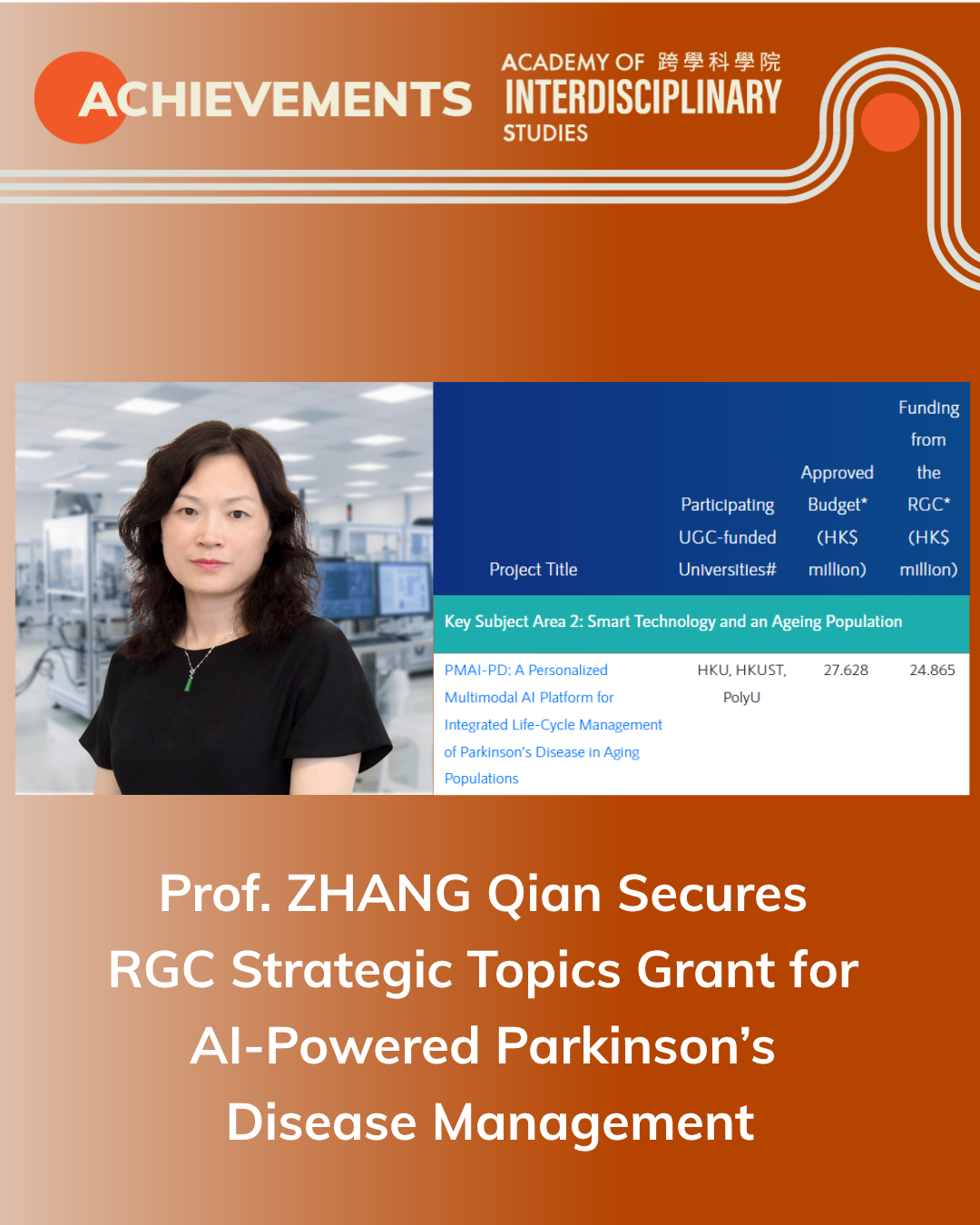
A research project led by Prof. ZHANG Qian, Head of the Division of Integrative Systems and Design (ISD), has been awarded 2026/27 Strategic Topics Grant (STG) from the Research Grants Council (RGC) under the University Grants Committee (UGC). Titled “PMAI-PD: A Personalized Multimodal AI Platform for Integrated Life-Cycle Management of Parkinson’s Disease in Aging Populations”, this project was funded under the “Smart Technology and an Ageing Population” area and received HKD 27.628 million in support (including university matching funds) for five years. It is one of only six projects selected in this highly competitive funding exercise.
Parkinson’s disease (PD) presents a rapidly growing public health challenge in aging societies. To address this issue, the research team will partner with frontline physicians and elder-care industry partners in the GBA to develop PMAI-PD, an AI-powered PD care platform that transforms PD management from a hospital-centric model into “hospital + home” care pathway. The platform aims to extend screening, monitoring, and rehabilitation into patients’ daily lives through the use of low-cost sensors and clinically validated AI models.
PMAI-PD comprises three integrated modules: (1) PMAI-PD screen, which enables early screening by integrating daily behavioral signals with clinical profiles, such as blood proteomic and neuroimaging signatures associated with early-stage PD; (2) PMAI-PD assess agent, which supports continuous home-based assessment by estimating PD symptoms through contactless and wearable sensing during everyday activities, enabling ecologically valid longitudinal monitoring; and (3) PMAI-PD rehab, which delivers personalized rehabilitation through an LLM-enabled agent that guides patients through exercises using the same home-based sensors, thereby improving patient adherence and enhancing therapist efficiency.
This funding testifies to the interdisciplinary research excellence demonstrated by Prof. Zhang and her team, underscoring their commitment to harnessing emerging technologies to address pressing healthcare challenges and drive meaningful societal impact.
Congratulations to Prof. Zhang and her team on this remarkable achievement!


