More about HKUST


Achievements
Community
Corporate Projects
Exchange
Field Trips & Visits
Internship & Career
Undergraduate
Office
Research
Seminars & forums
Student Activities
T&M-DDP
Postgraduate
EVMT
Innovation
Entrepreneurship
Sustainability
Engineering
Environment
Air Quality
GBA
PublicPolicy
ENVR
PPOL
Teaching&Learning
Technology
Research and Technology
Greater Bay Area
IIM
Fintech
Alumni
AMC
Art Management
Artificial Intelligence
Arts
ArtTech
Cultural Studies
DesignTech
Emerging Interdisciplinary Areas
EMIA
Extended Majors
Faculty
HealthTech
IDT
ISD
Machine Creativity
MarineTech
MPM
MPP
SustainableTech
TIE
TLE
Achievements & Competitions
Prof. Sai-Kit YEUNG Honored with CVPR 2026 Outstanding Area Chair Award
20/07/2026
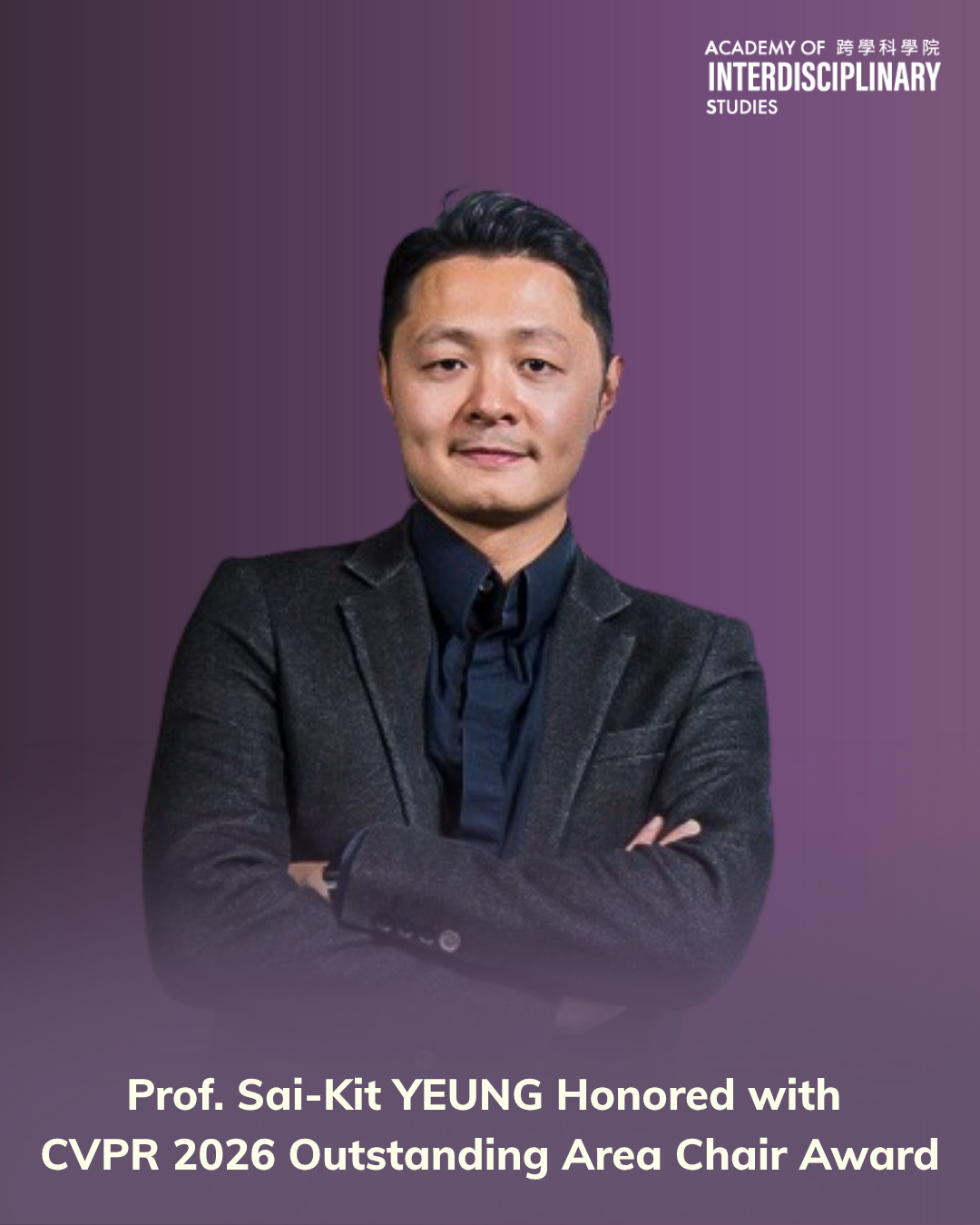
Prof. Sai-Kit YEUNG, Professor in the Division of Integrative Systems and Design (ISD), has been honored with the CVPR 2026 Outstanding Area Chair Award in recognition of his exceptional leadership and service in supporting the peer-review process at the IEEE/CVF Conference on Computer Vision and Pattern Recognition (CVPR) 2026.
At CVPR 2026, Prof. Yeung also served as a Lead Area Chair, a role entrusted to experienced members of the research community. In this capacity, he coordinated review activities, facilitated technical discussions, and helped ensure a fair, rigorous, and high-quality review process for numerous submissions.
Prof. Yeung is internationally recognized for his research in artificial intelligence (AI), 3D computer vision, computer graphics, and marine AI. His work spans 3D and 4D scene reconstruction, visual understanding, foundation models for complex visual environments, AI-driven content generation, computational design, and embodied perception. In recent years, he has also pioneered AI technologies for marine science and sustainability, including underwater visual understanding, semantic mapping, and AI-assisted marine conservation.
This recognition reflects both Prof. Yeung’s scholarly expertise and his sustained leadership within the international computer vision community. Beyond his research contributions, he has played active roles in major conferences and journals across computer vision, AI, computer graphics, and robotics. His selection as an Outstanding Area Chair underscores his dedication to maintaining excellence, fairness, and integrity in the peer-review process.
Congratulations to Prof. Yeung on this well-deserved recognition!
About CVPR 2026
CVPR 2026 was held in Denver, Colorado, USA, from June 3 to 7, 2026. Together with the International Conference on Computer Vision (ICCV) and the European Conference on Computer Vision (ECCV), CVPR is widely regarded as one of the top international conferences in the field of computer vision and artificial intelligence.
In 2026, the conference attracted 16,092 submissions. Supported by six Program Chairs, 41 Senior Area Chairs, 909 Area Chairs, and 25,149 reviewers, the review process generated more than 48,000 reviews. Ultimately, 4,072 papers were accepted into the conference program, highlighting the conference's highly competitive nature.


