More about HKUST


Achievements
Community
Corporate Projects
Exchange
Field Trips & Visits
Internship & Career
Undergraduate
Office
Research
Seminars & forums
Student Activities
T&M-DDP
Postgraduate
EVMT
Innovation
Entrepreneurship
Sustainability
Engineering
Environment
Air Quality
GBA
PublicPolicy
ENVR
PPOL
Teaching&Learning
Technology
Research and Technology
Greater Bay Area
IIM
Fintech
Alumni
AMC
Art Management
Artificial Intelligence
Arts
ArtTech
Cultural Studies
DesignTech
Emerging Interdisciplinary Areas
EMIA
Extended Majors
Faculty
HealthTech
IDT
ISD
Machine Creativity
MarineTech
MPM
MPP
SustainableTech
TIE
TLE
Research and Innovation
New Collaborative Research by Prof. Masaru YARIME Reveals the Structure of Scientific Influence in Global Policymaking
13/05/2026
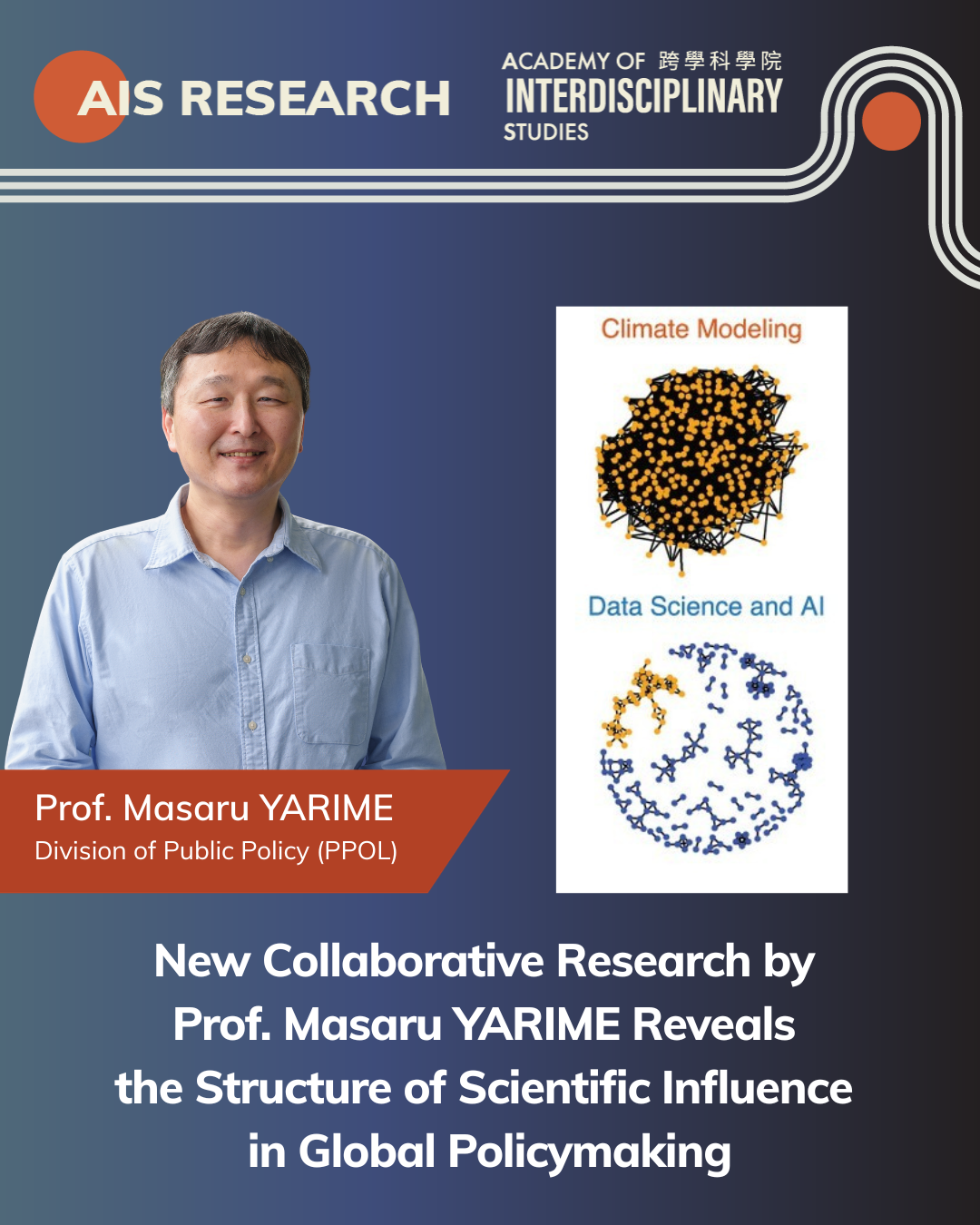
Prof. Masaru YARIME, Associate Professor in the Division of Public Policy (PPOL), in collaboration with researchers at the University of Tokyo and University College London, has examined how intergovernmental organizations (IGOs) incorporate scientific knowledge into global policymaking. The study was recently published in the prestigious multidisciplinary scientific journal Proceedings of the National Academy of Sciences (PNAS).
IGOs, such as the Intergovernmental Panel on Climate Change and the World Health Organization, draw extensively on scientific research to produce influential policy reports and guidelines. While they depend heavily on scientific evidence, these organizations do not conduct research themselves, but instead select and synthesize studies produced by external scientists. Previous research has examined individual citations or geographic representation, but has not systematically explained how scientific influence is structured at the level of individual scientists.
To address this gap, the research team analyzed over 230,000 scientific papers cited in IGO documents between 2015 and 2023, spanning 23 research fields. The study finds that scientific input to IGO documents is highly concentrated, with a small share of scientists accounting for a large proportion of cited research. These scientists tend to see their work adopted more rapidly into policy documents and cited by multiple IGOs.
The findings further show that highly cited scientists are embedded in dense international collaboration networks, and often adopt standardized and policy‑oriented research approaches. This concentration is particularly strong in well‑established fields such as climate modeling, while emerging areas such as data science and artificial intelligence show more distributed citation patterns. These structures remain largely stable over time, following a geographic core–periphery pattern centered on Western Europe—, despite ongoing efforts by IGOs to broaden participation and diversify their evidence base.
By making these patterns visible at the author level, the study offers a new framework for understanding how scientific knowledge flows into global decision‑making and informs debates on credibility, efficiency, and legitimacy in the science–policy interface.


