More about HKUST
Achievements
Community
Corporate Projects
Exchange
Field Trips & Visits
Internship & Career
Undergraduate
Office
Research
Seminars & forums
Student Activities
T&M-DDP
Postgraduate
EVMT
Innovation
Entrepreneurship
Sustainability
Engineering
Environment
Air Quality
GBA
PublicPolicy
ENVR
PPOL
Teaching&Learning
Technology
Research and Technology
Greater Bay Area
IIM
Fintech
Alumni
AMC
Art Management
Artificial Intelligence
Arts
ArtTech
Cultural Studies
DesignTech
Emerging Interdisciplinary Areas
EMIA
Extended Majors
Faculty
HealthTech
IDT
ISD
Machine Creativity
MarineTech
MPM
MPP
SustainableTech
TIE
TLE
Announcements & Office
Meet Our Faculty: Prof. Jack XING Linzhou
25/08/2026
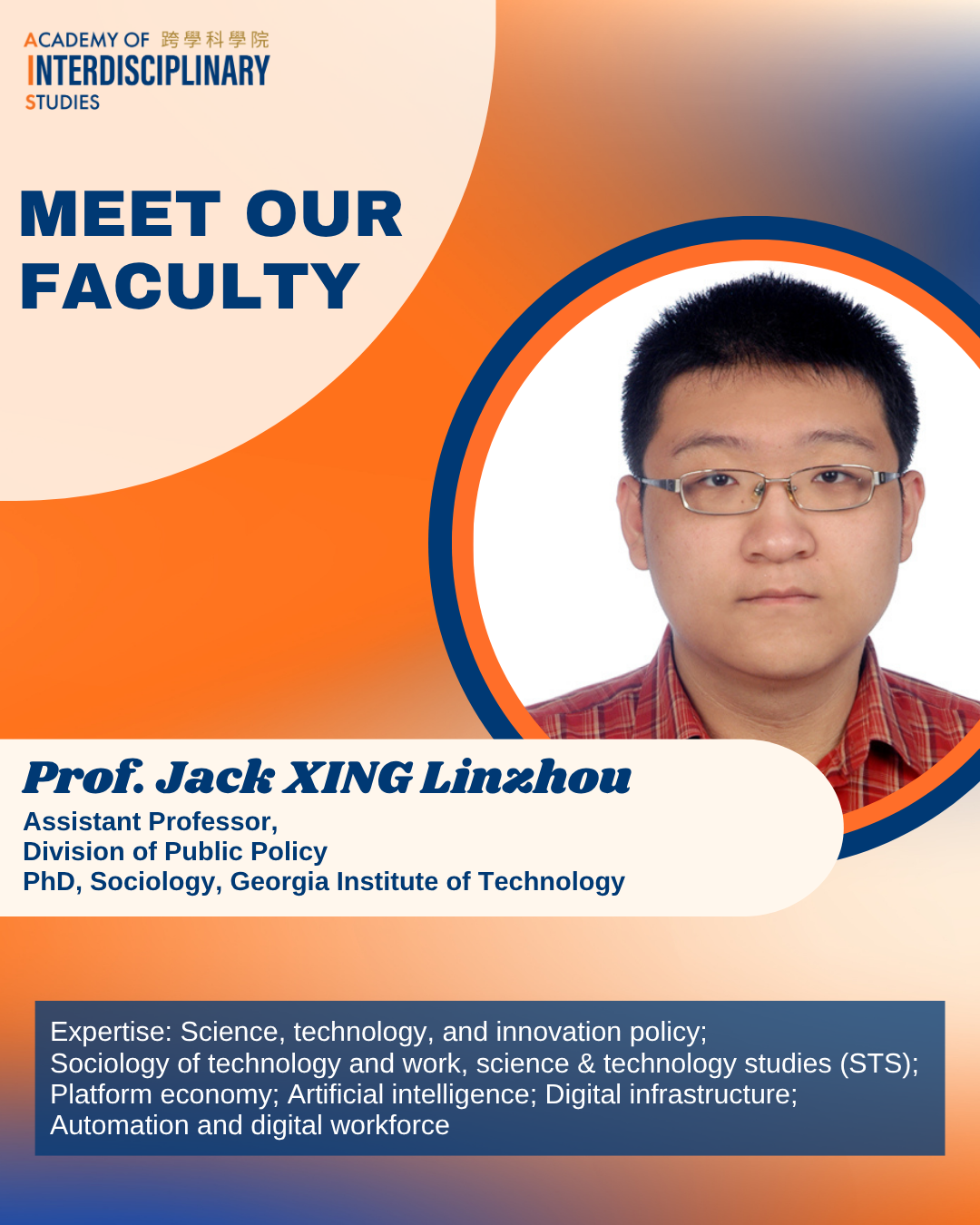
Welcome Prof. Jack XING Linzhou, who has recently joined the Division of Public Policy (PPOL) as an Assistant Professor.
Driven by an interest in how technology transforms everyday life, Prof. Xing researches the opportunities and challenges created by the platform economy, automation, and emerging digital technologies. His work examines how innovation shapes work, society, and governance, and how policymakers can steer technological development toward more inclusive and socially beneficial outcomes.
Read on to learn more about his research journey and advice for students.
-----
Could you tell us more about you?
I am originally from Xi’an, China, a city with a history of over 3,000 years. Before joining HKUST, I earned my PhD from the Georgia Institute of Technology in the US and worked as a postdoctoral fellow at Harvard University. Interestingly, HKUST is my master’s alma mater, so I am very excited and feel very lucky to return as a faculty member.
My research focuses on the social, labor, political, and policy implications of the platform economy (particularly ride-hailing services), digital automation and the future of work, and innovation policies in China. In the coming Fall term, I will teach the postgraduate course PPOL 5310 “Public Management for Technology Innovation”.
What inspired you to specialize in this line of research?
I first became interested in the topic of technological innovation and future of work when I saw taxi drivers in my hometown, Xi’an, who once lived in quite satisfying conditions, start to struggle after ride-hailing platforms like Didi expanded rapidly across the country. This made me think critically about the winners and losers, as well as the benefits and challenges brought by new digital technology to our society.
Since then, I have been studying the complicated impact of digital infrastructure and automation technologies on different countries and societies, and, vice versa, how different countries and societies, especially China, on the one hand nurture technological innovation and on the other hand contain their potential side effects. This has become increasingly important and urgent in recent years, especially because of the rapid development of AI-related technologies and the significant benefits, as well as the disruption they have brought.
What impact do you want your work to have on society?
Much of my research focuses on addressing the sociopolitical challenges of automation for work, and balancing the development and governance of emerging technologies. I hope my research can help policymakers and citizens to break through the traditional mindsets of technological determinism, technological optimism, and technological pessimism, so that they can have a better idea about how technology influences society in very diverse, nuanced, and unanticipated, albeit important ways. At the same time, I hope to highlight how public policy and civil society forces can steer the development of technology towards a collectively constructed and negotiated direction.
Do you have any advice for students interested in your research area?
Try to broaden your horizons and explore beyond the boundaries of your disciplinary training. Maintain both constructive and critical perspectives on technology-related social issues. Most importantly, ask questions based on observations of practical phenomena instead of relying solely on textbooks and theories.
Could you share a fun fact about you?
I can recognize the national flags and name the capitals of almost every country in the world.