More about HKUST


Achievements
Community
Corporate Projects
Exchange
Field Trips & Visits
Internship & Career
Undergraduate
Office
Research
Seminars & forums
Student Activities
T&M-DDP
Postgraduate
EVMT
Innovation
Entrepreneurship
Sustainability
Engineering
Environment
Air Quality
GBA
PublicPolicy
ENVR
PPOL
Teaching&Learning
Technology
Research and Technology
Greater Bay Area
IIM
Fintech
Alumni
AMC
Art Management
Artificial Intelligence
Arts
ArtTech
Cultural Studies
DesignTech
Emerging Interdisciplinary Areas
EMIA
Extended Majors
Faculty
HealthTech
IDT
ISD
Machine Creativity
MarineTech
MPM
MPP
SustainableTech
TIE
TLE
Announcements & Office
Meet Our Faculty: Prof. YAO Kuanming
23/04/2026
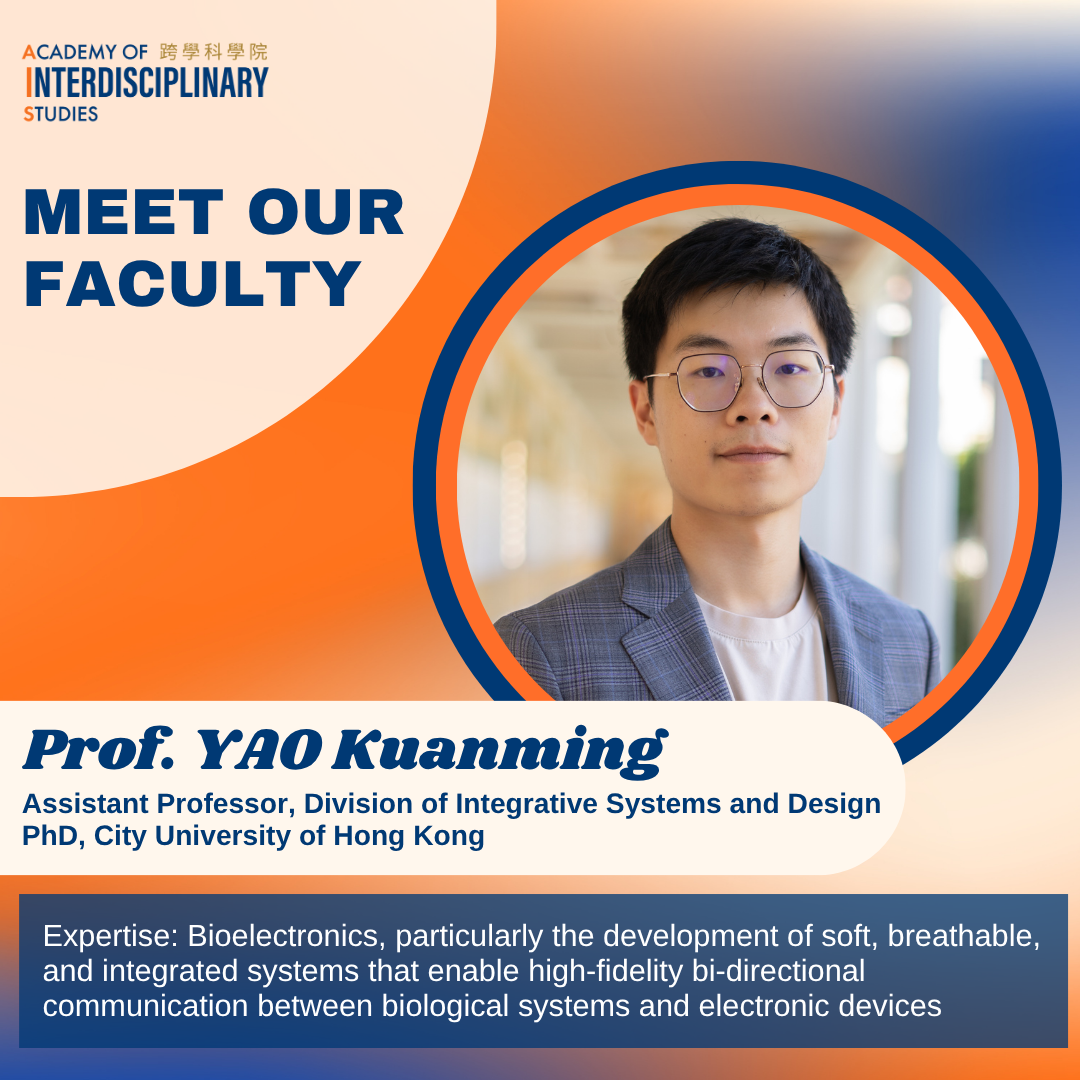
Prof. YAO Kuanming, who recently joined the Division of Integrative Systems and Design as Assistant Professor, brings his expertise in the evolving field of bioelectronics to HKUST.
Specializing in the development of soft, breathable, and integrated systems that enable high-fidelity bi-directional communication between biological systems and electronic devices, Prof. Yao’s vision is to create a universal and highly efficient interface between the human body and technology to improve global healthcare and human capability.
Read on to discover his research journey, advice for students, and how he recharges outside the lab.
-----
Could you tell us more about you?
I come from Shantou, Guangdong, a beautiful seaside city famous for its cuisine. Prior to joining HKUST, I was a postdoctoral fellow at UCLA, and before that I obtained my PhD degree in City University of Hong Kong. HKUST has always been my dream school because of its strong culture of innovation, its highly collaborative environment, and the young and energetic vibe. My research sits at the intersection of electronics, materials, healthcare, and human-machine interaction, so HKUST is an ideal place for me to develop new technologies while also building collaborations across engineering, medicine, and design. I was especially attracted by the university’s emphasis on translating fundamental research into real-world impact.
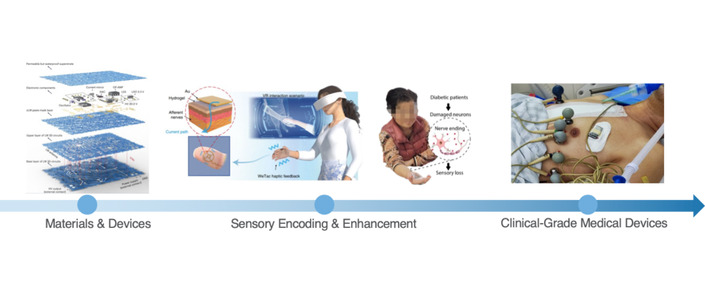
I am currently working on bioelectronics for bridging between human body and the machine intelligence as a gateway for health and sensory information. Haptic interfaces, for example, can make the touching of virtual objects perceivable, and furthermore may help to restore some lost sensory functions of neuropathy patients. I love my research because of its potential to actually help people, even if it’s just a little bit.
What inspired you to specialize in this line of research?
The concept of “electronic skin” that emerged around 2011 actually was something inspired me to work in the bioelectronics field. This was so cool that it subverted my imagination about electronics as they were previously always rigid and boring. By becoming soft and stretchable, it unlocks vast possibilities for integrating with fragile biological tissues, and has revolutionized the way that information exchanges between the human body and machines. That’s the moment I realize this technology may make scenes from science-fiction movies (like The Matrix, Iron Man, etc.) happen. And after years of development, various novel applications in personalized healthcare, human-machine interactions, brain-machine interfaces, energy harvesting, and even in virtual reality have been demonstrated through soft bioelectronics. Such a “future coming true” moment is so exciting to me.
What impact do you want your work to have on society?
I hope my work can broadly improve the way technology supports human health and human capability. On the one hand, I aim to develop bioelectronic systems for continuous health monitoring, enabling earlier detection, better care, and more personalized treatment, which makes good healthcare more easier available to everyone. On the other, I hope to create sensory interfaces that can help people with impaired perception regain access to sensory information and interact with the world more effectively. More generally, I want to build technologies that make the connection between the human body and electronic systems easier, more natural, and more beneficial in everyday life.
Do you have any advice for students interested in your research area?
I believe good research should originate from practical needs in real life and be driven by bold imagination. This means staying down-to-earth, remaining enthusiastic about life, caring about the people around you, and at the same time not being limited by the boundaries of your knowledge or by assumptions about how things are supposed to work. To me, the most fascinating part of interdisciplinary research such as bioelectronics is discovering ways to make seemingly impossible ideas possible. More importantly, it is the passion for solving real problems that should drive you forward, rather than anything else.
Could you share a fun fact about you?
I actually play some guitar when not too busy; my favorite song to play is John Mayer’s Neon.