More about HKUST


Achievements
Community
Corporate Projects
Exchange
Field Trips & Visits
Internship & Career
Undergraduate
Office
Research
Seminars & forums
Student Activities
T&M-DDP
Postgraduate
EVMT
Innovation
Entrepreneurship
Sustainability
Engineering
Environment
Air Quality
GBA
PublicPolicy
ENVR
PPOL
Teaching&Learning
Technology
Research and Technology
Greater Bay Area
IIM
Fintech
Alumni
AMC
Art Management
Artificial Intelligence
Arts
ArtTech
Cultural Studies
DesignTech
Emerging Interdisciplinary Areas
EMIA
Extended Majors
Faculty
HealthTech
IDT
ISD
Machine Creativity
MarineTech
MPM
MPP
SustainableTech
TIE
TLE
Research and Innovation
China Daily Interviews Prof. CHEN Fei on Extreme Weather and Urban Climate Resilience
25/06/2026
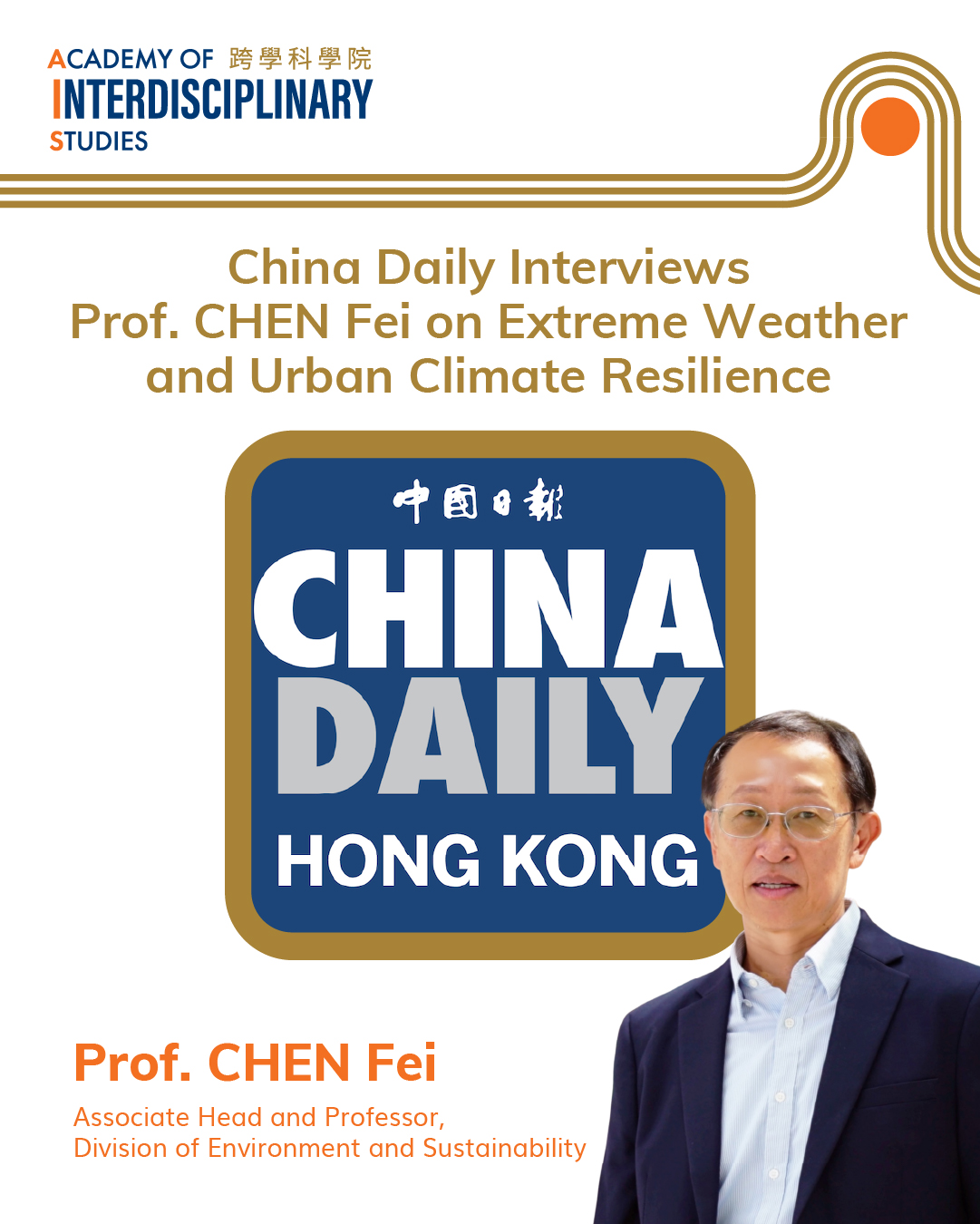
Predicting extreme weather in dense cities like Hong Kong has become a monumental challenge, but shifting toward "impact-based warnings" is the key to saving lives and preventing social breakdowns. Prof. CHEN Fei, Associate Head and Professor in the Division of Environment and Sustainability, shared insights with China Daily Hong Kong on the extreme weather and climate resilience recently.
As an internationally acclaimed expert in atmospheric sciences, urban climatology, and hydrometeorology, Prof. Chen noted that current forecasting models struggle heavily in environments like Hong Kong. The city lies in a typhoon-and-monsoon-active cyclone belt, while the intimidating density of the high-rise buildings triggers the urban heat island effect. This “concrete forest”, combined with the mountainous terrain and long coastline, alters cloud formation and causes rainfall intensity to vary sharply by district, thus making weather prediction particularly difficult.
While Prof. Chen praised the Hong Kong Observatory’s world-class reputation in typhoon monitoring and public communication, he emphasized that the future of forecasting should rely on impact-based warnings. Rather than just reporting wind strength or rainfall volume, public warnings should also incorporate the weather’s potential economic and social effects, collaboration among sectors, and how communities should get involved in prevention work.
Referencing Hong Kong’s “once-in-a-century” rainstorm in September 2023, Prof. Chen believed that the impact-based weather warning system is the right direction in climate adaptation.
Read the full article: https://www.chinadailyhk.com/hk/article/634486


