More about HKUST


Achievements
Community
Corporate Projects
Exchange
Field Trips & Visits
Internship & Career
Undergraduate
Office
Research
Seminars & forums
Student Activities
T&M-DDP
Postgraduate
EVMT
Innovation
Entrepreneurship
Sustainability
Engineering
Environment
Air Quality
GBA
PublicPolicy
ENVR
PPOL
Teaching&Learning
Technology
Research and Technology
Greater Bay Area
IIM
Fintech
Alumni
AMC
Art Management
Artificial Intelligence
Arts
ArtTech
Cultural Studies
DesignTech
Emerging Interdisciplinary Areas
EMIA
Extended Majors
Faculty
HealthTech
IDT
ISD
Machine Creativity
MarineTech
MPM
MPP
SustainableTech
TIE
TLE
Research and Innovation
HKUST Establishes Center for Marine Intelligence and Partners with KAUST to Launch Inaugural AI4Coral Research Project
18/11/2026
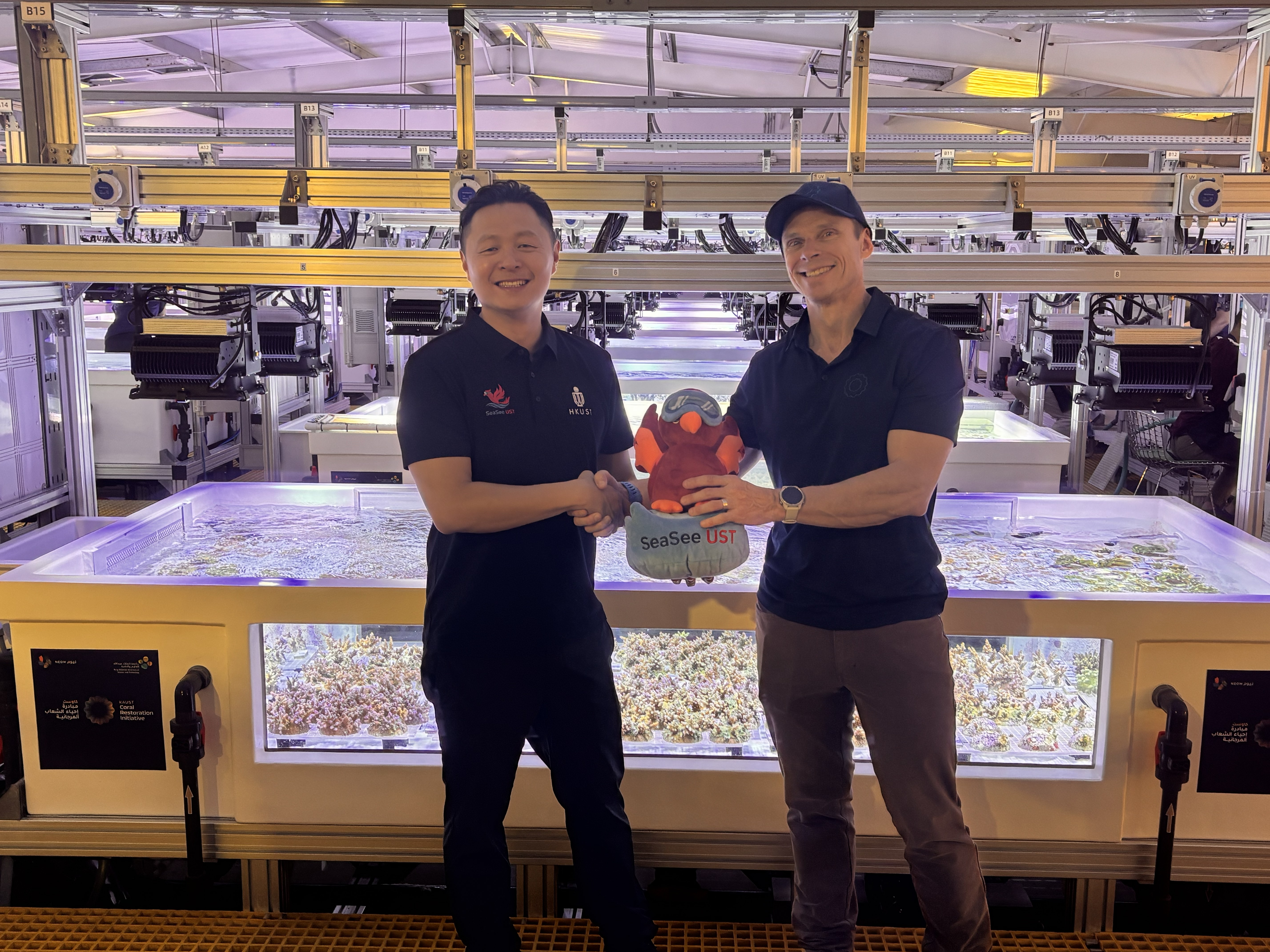
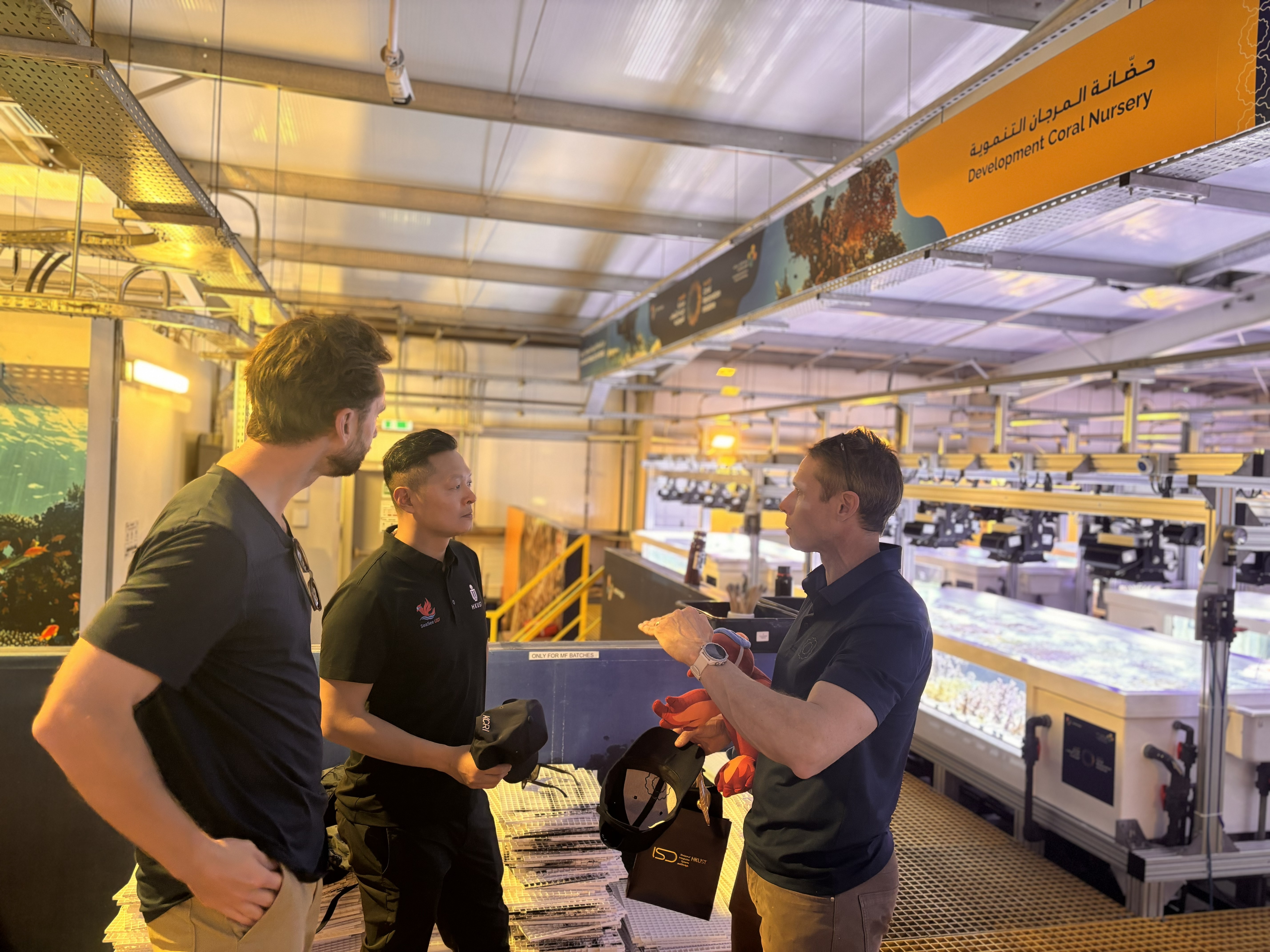
Prof. YEUNG Sai-Kit (left), Founding Director of HKUST’s Center for Marine Intelligence, and Prof. David SUGGETT (right), Director of the KAUST Coral Restoration Initiative (KCRI), with a SeaSeeUST souvenir during the visit to KCRI’s Development Nursery.
The Hong Kong University of Science and Technology (HKUST) has recently established the Center for Marine Intelligence (CMI), combining artificial intelligence (AI), robotics, and marine science to deepen global understanding of the ocean and build resilient, sustainable marine ecosystems. Led by Prof. YEUNG Sai-Kit, Professor in the Division of Integrative Systems and Design (ISD) and the Founding Director of CMI at HKUST, alongside CMI’s Associate Directors Prof. Rob SCHARFF, Assistant Professor in ISD, and Prof. HU Wenqi, Assistant Professor in the Department of Mechanical and Aerospace Engineering (MAE), the Center leverages HKUST’s interdisciplinary research strengths to advance ocean observation, autonomous exploration, biodiversity research, and ecological conservation.
Coral reefs support fisheries, tourism, coastal protection, and ecosystem services that directly or indirectly benefit more than 10% of the world's population. As climate change and human pressures continue to threaten reef ecosystems, innovative monitoring solutions are increasingly vital. To address this challenge, CMI is launching its inaugural international research project, “AI4Coral: Automated Coral Reef Monitoring and Analysis Across In-Situ and Ex-Situ Environments,” in collaboration with the KAUST Coral Restoration Initiative (KCRI) at King Abdullah University of Science and Technology (KAUST).
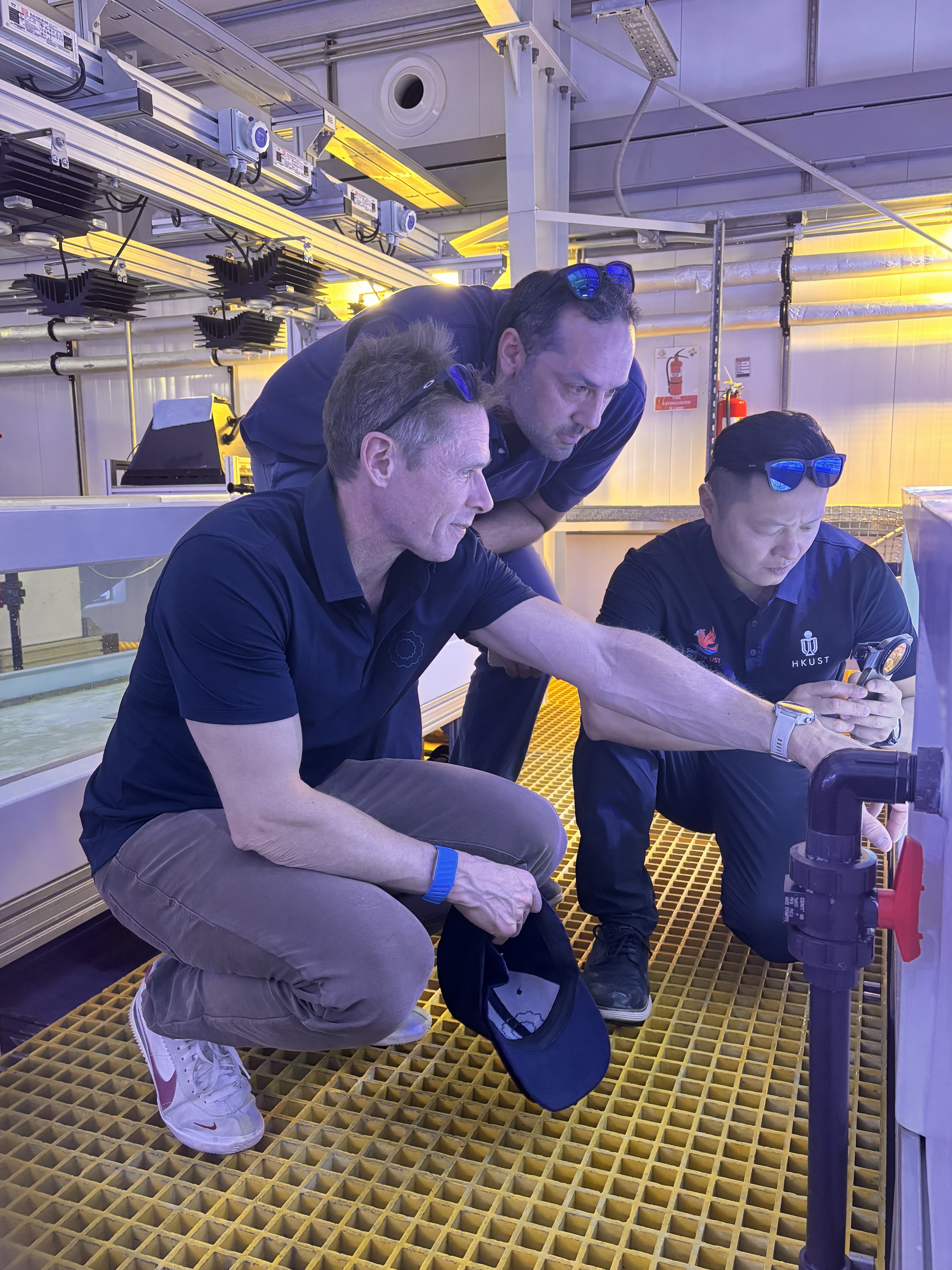
Co-led by Prof. Yeung, Prof. David SUGGETT, Director of KCRI, and Dr. Liz GOERGEN of KCRI, the project connects HKUST’s expertise in AI and robotics with the world’s largest coral reef restoration program, combining in-water (in-situ) and land-based (ex-situ) coral nursery facilities, restoration expertise, and field operations in the NEOM region to advance automated coral monitoring and analysis.
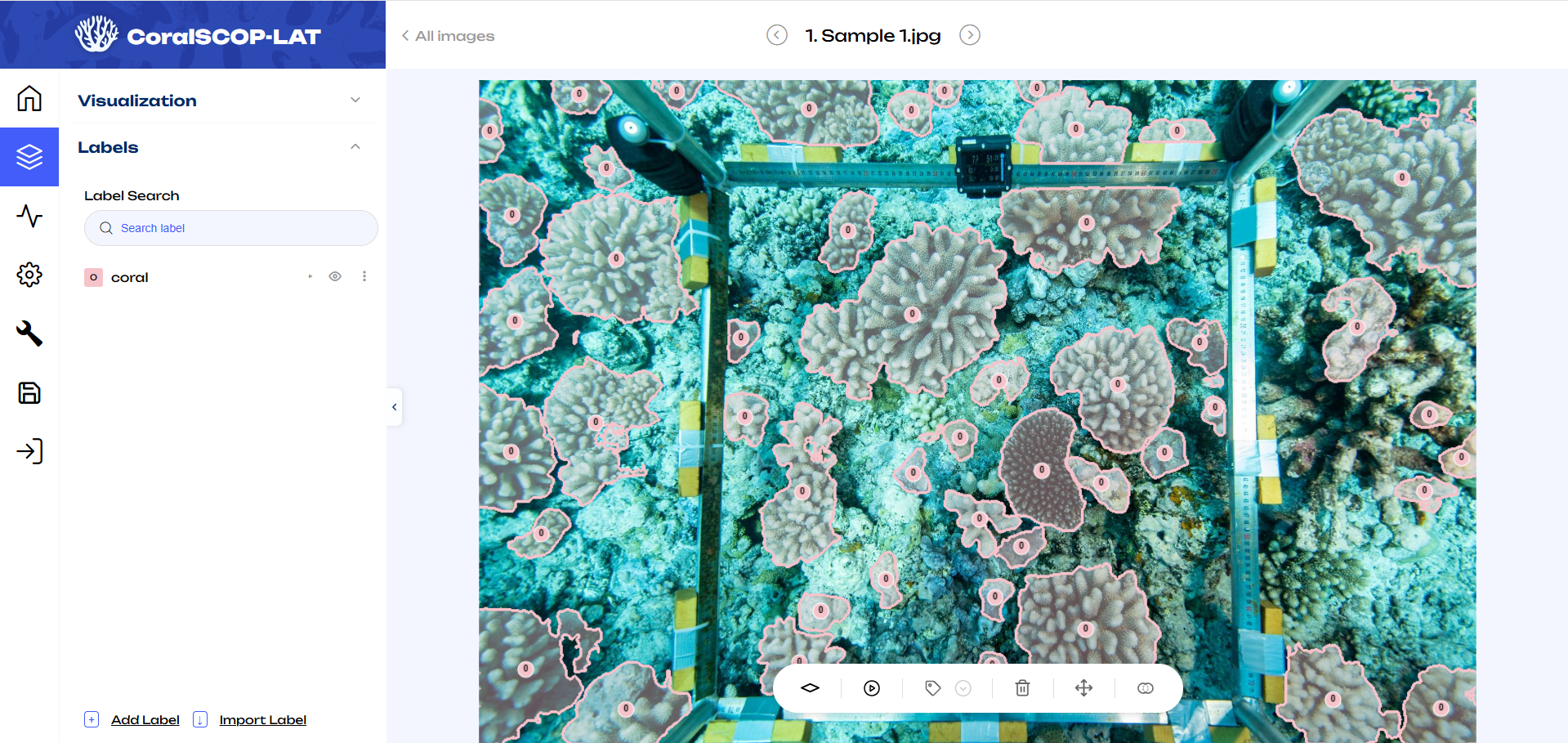
Compared with traditional point-sampling tools, HKUST’s Coral AI model performs full-image dense segmentation in a fully automatic manner, completing image-analysis over 1,000 times faster. For a 500 × 500-pixel image, it classifies all 250,000 pixels, providing 5,000 times as many classified image locations as a 50-point manual annotation. Through this collaboration, the teams aim to further develop the model to support KCRI’s coral restoration efforts, with the goal of deploying it directly on edge underwater devices as the system's eyes and brain. The AI model is designed to autonomously identify targeted coral regions in real time and support the calculation of key health metrics, including coral cover, growth rate, species diversity, and bleaching rate. This technology is set to be integrated with underwater robotic platforms from the KAUST research team.
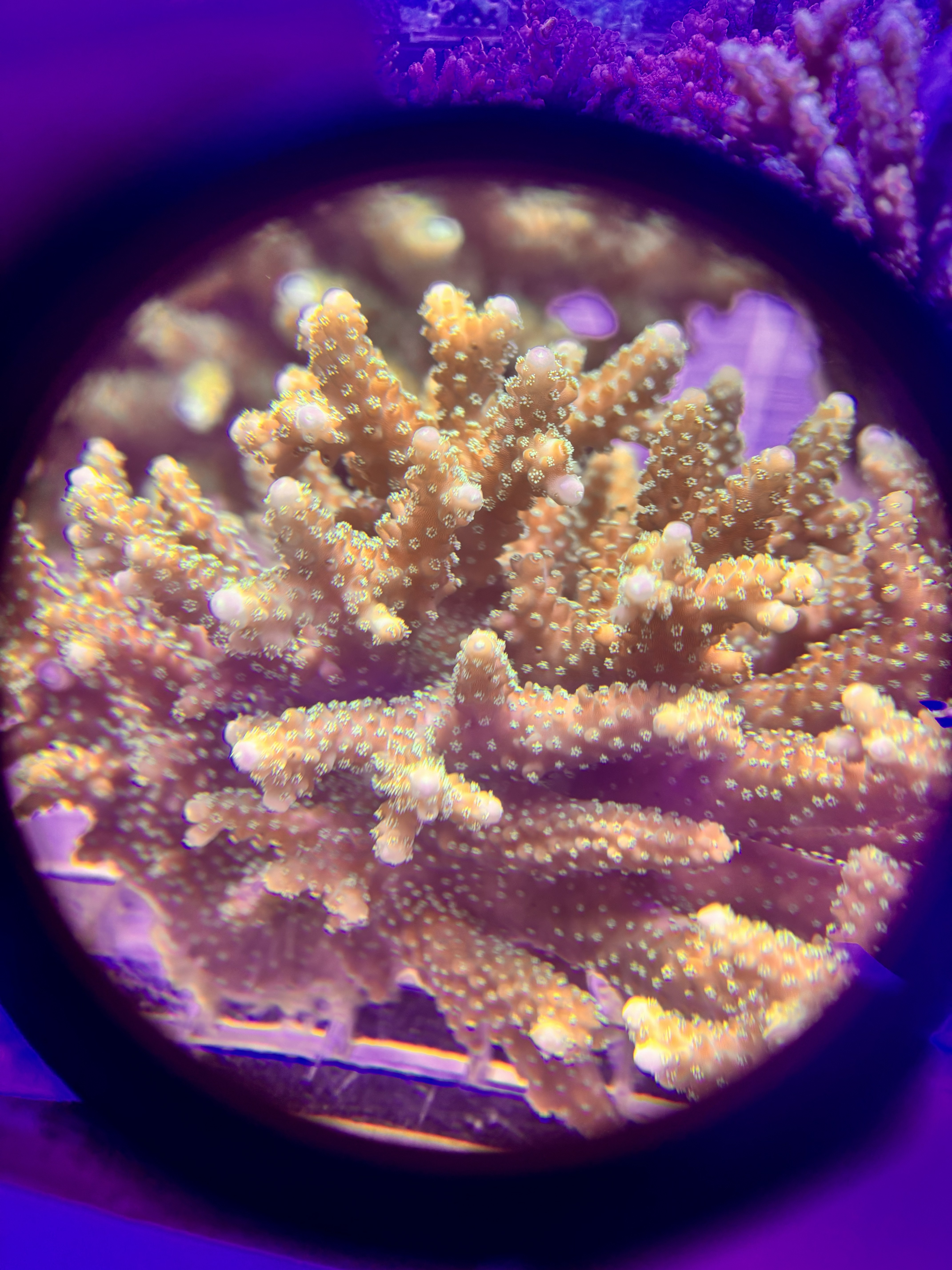
A preliminary version of the model has been tested on imagery from the Red Sea and KAUST’s in-water and land-based coral nurseries, as well as reef imagery from Hong Kong’s Hoi Ha Wan provided through collaboration with WWF-Hong Kong. Broader field validation is ongoing.
Prof. YEUNG Sai-Kit, Professor in the Division of ISD and Founding Director of CMI at HKUST, said: "Coral reef monitoring has traditionally relied on time-consuming surveys and manual image analysis. By combining novel technologies and knowledge across AI, robotics, and marine science, this collaboration aims to enable faster, more scalable, and data-driven assessments of reef health. We hope these technologies will support scientists and conservation practitioners in making more informed decisions to jointly protect and restore coral reef ecosystems."
Prof. David SUGGETT, Director of KCRI, said: "We are excited about this collaboration between two world-leading universities, bringing together HKUST’s innovations in coral reef analytical platforms and KAUST’s expertise in scaling coral conservation and reef restoration. Through this collaboration, HKUST researchers will work alongside KAUST faculty and the KCRI team to advance automated reef health assessment using AI and machine learning, building on existing research strengths and opening further opportunities for joint research."
Building on its core research, CMI is extending its AI capabilities to reconstruct 3D reef structures from field transect videos, with support from HKUST’s Ocean Central Research Facility and Sustainable Smart Campus Office. Related coral-monitoring research is also supported by the Environment and Conservation Fund. Globally, the team has shared its research at the 16th International Coral Reef Symposium in Auckland and is pursuing further collaboration through a multi-region CORDAP proposal and ongoing discussions with OceanX.
CMI’s broader portfolio encompasses the Sustainable Smart Marine Grid, the Sustainable Smart Campus Pier Living Lab, multi-domain aerial-surface-underwater robotic platforms, and bio-inspired soft robotic fish and jellyfish drones led by Prof. Scharff and Prof. Hu. Leveraging HKUST's accessible shoreline, CMI integrates AI, robotics, and marine ecology to advance ocean monitoring, STEAM education, and community conservation.
Click here to read the original press release on HKUST website.
Prof. YEUNG Sai-Kit (left), Founding Director of HKUST’s Center for Marine Intelligence, and Prof. David SUGGETT (right), Director of the KAUST Coral Restoration Initiative (KCRI), with a SeaSeeUST souvenir during the visit to KCRI’s Development Nursery.