More about HKUST


Achievements
Community
Corporate Projects
Exchange
Field Trips & Visits
Internship & Career
Undergraduate
Office
Research
Seminars & forums
Student Activities
T&M-DDP
Postgraduate
EVMT
Innovation
Entrepreneurship
Sustainability
Engineering
Environment
Air Quality
GBA
PublicPolicy
ENVR
PPOL
Teaching&Learning
Technology
Research and Technology
Greater Bay Area
IIM
Fintech
Alumni
AMC
Art Management
Artificial Intelligence
Arts
ArtTech
Cultural Studies
DesignTech
Emerging Interdisciplinary Areas
EMIA
Extended Majors
Faculty
HealthTech
IDT
ISD
Machine Creativity
MarineTech
MPM
MPP
SustainableTech
TIE
TLE
Institutional Advancement
HKUST AIS and LSE Advance Collaboration in AI Governance, Research and Education
21/09/2026
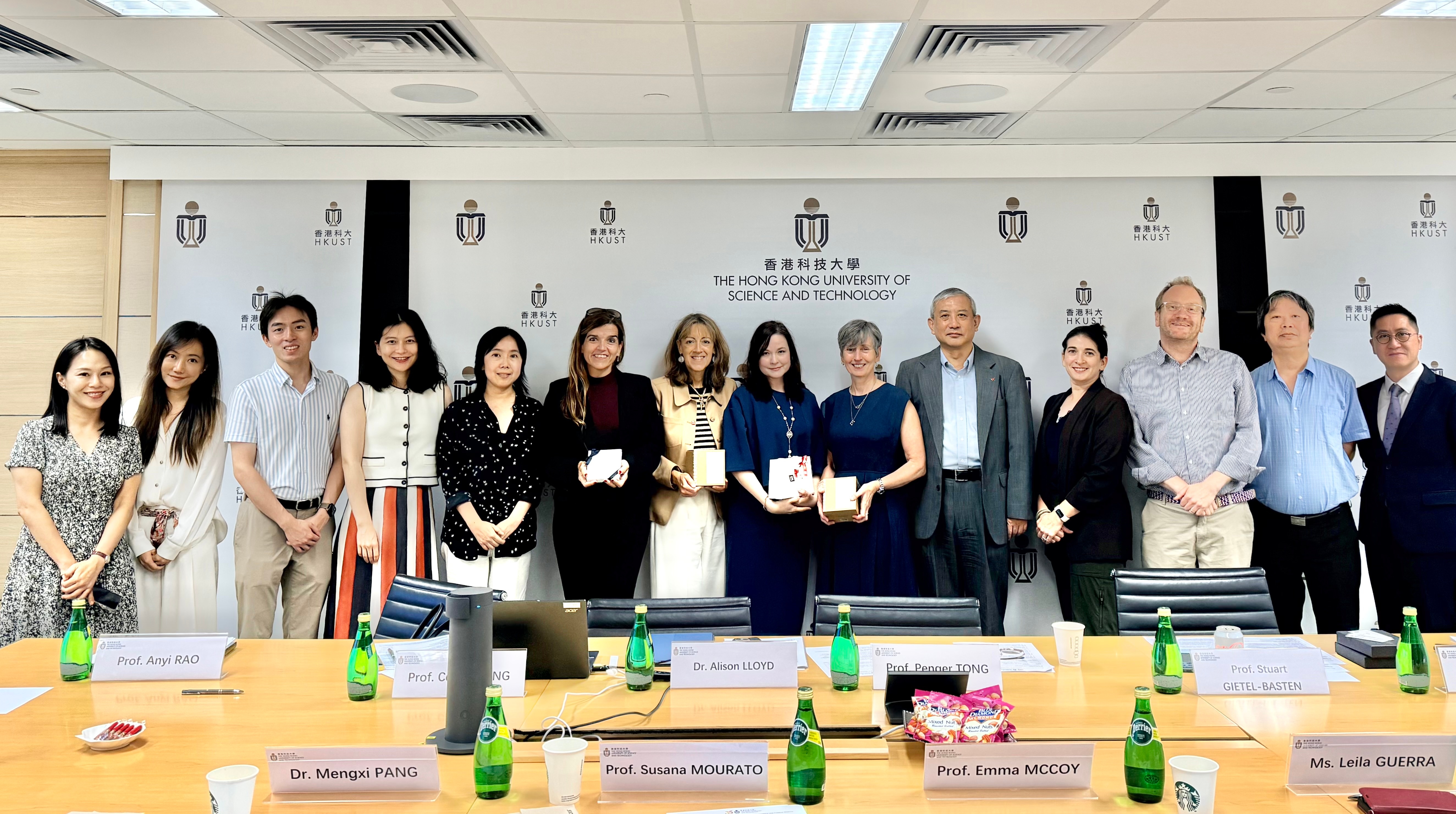
The Academy of Interdisciplinary Studies (AIS) at The Hong Kong University of Science and Technology (HKUST) welcomed a senior delegation from the London School of Economics and Political Science (LSE) to the HKUST campus on September 10, advancing collaboration in AI governance, interdisciplinary research and education following discussions initiated during AIS’s earlier visit to Europe.
This visit followed an earlier AIS delegation trip to LSE led by Professor QU Huamin, Dean of AIS, during which the two institutions identified strong complementarities and explored initial possibilities for collaboration. The latest exchange in Hong Kong marked a step toward translating these conversations into more concrete areas of cooperation between the two institutions.
The LSE delegation, bringing together senior leadership in research, education, and global partnerships, was led by Professor Susana MOURATO, Vice President and Pro-Vice Chancellor (Research), and Professor Emma MCCOY, Vice President and Pro-Vice Chancellor (Education), together with Ms. Leila GUERRA, Associate Vice President (Education), and Dr. PANG Mengxi , Senior Manager (Global Research Partnerships and Alliances) from LSE’s International Strategy and Academic Partnerships team.
The visit opened with a university-wide discussion led by Dr Alison E. LLOYD, Associate Provost (Academic Strategy and Data Analytics), and Professor TONG Penger, Associate Vice-President for Research and Development (Research), before turning to the AIS–LSE initiatives. They were joined by colleagues from across HKUST, including Professor Stuart GIETEL-BASTEN, Associate Dean of Humanities and Social Science (Research); Professor Alexis LAU Kai-Hon, Head and Chair Professor of the Division of Environment and Sustainability; Professor Celine SONG Yunya, Head and Professor of the Division of Emerging Interdisciplinary Areas; Professor Kira MATUS, Acting Head and Professor of the Division of Public Policy; Assistant Professor RAO Anyi and Assistant Professor XUE Wei of the Division of Arts and Machine Creativity; and Mr. Eric LO, Head (Global Intelligence and Strategy).
Building a Global AI Governance Observatory
A major focus of the meeting was the proposed Global AI Governance Observatory. Professor Song, Director of the Media Intelligence Research Center, who leads the initiative, presented the Observatory’s conceptual framework and an AI-enabled prototype demonstration to the delegation.
The initiative starts from an increasingly urgent question: “Can institutions keep pace with AI?” Its development has already benchmarked 27 leading AI governance platforms and 58 functional modules worldwide, mapping the strengths and gaps of existing policy trackers, readiness assessments, governance indices, incident monitors and risk frameworks. Building on this global landscape analysis, the team has developed an initial architecture comprising five interconnected systems and 26 capabilities for a new generation of AI governance intelligence.
Designed as theory-informed, AI-empowered and human-governed, the Observatory goes beyond conventional policy databases. Multilingual AI will support continuous discovery, linkage and temporal analysis across policies, institutions, technological developments, deployment and emerging risks, while expert oversight remains central to interpretation and governance judgment. The aim is to move from simply tracking what AI governance exists to diagnosing whether governance is keeping pace with the AI world it is expected to govern.
The proposed collaboration seeks to draw on complementary strengths: LSE brings expertise in institutional theory, public policy, law, political economy and comparative social science, while AIS brings capabilities in AI, computational social science, multilingual intelligence and data processing, and research grounded in Asian AI ecosystems.
AI and the Future of Education
AI and the future of education formed another important strand of the discussion. Participants exchanged views on how AI is reshaping physical and digital learning environments, technology-enabled pedagogies, new approaches to teaching and assessment, and the evolving relationship among tutors, students and AI systems.
Both sides explored opportunities for collaboration in AI-empowered education and lifelong learning, including new forms of adaptive and interdisciplinary learning, and extending education beyond conventional classroom and degree structures.


