More about HKUST


Achievements
Community
Corporate Projects
Exchange
Field Trips & Visits
Internship & Career
Undergraduate
Office
Research
Seminars & forums
Student Activities
T&M-DDP
Postgraduate
EVMT
Innovation
Entrepreneurship
Sustainability
Engineering
Environment
Air Quality
GBA
PublicPolicy
ENVR
PPOL
Teaching&Learning
Technology
Research and Technology
Greater Bay Area
IIM
Fintech
Alumni
AMC
Art Management
Artificial Intelligence
Arts
ArtTech
Cultural Studies
DesignTech
Emerging Interdisciplinary Areas
EMIA
Extended Majors
Faculty
HealthTech
IDT
ISD
Machine Creativity
MarineTech
MPM
MPP
SustainableTech
TIE
TLE
Announcements & Office
Meet Our Faculty: Mr. Terence CHEUNG
18/09/2026
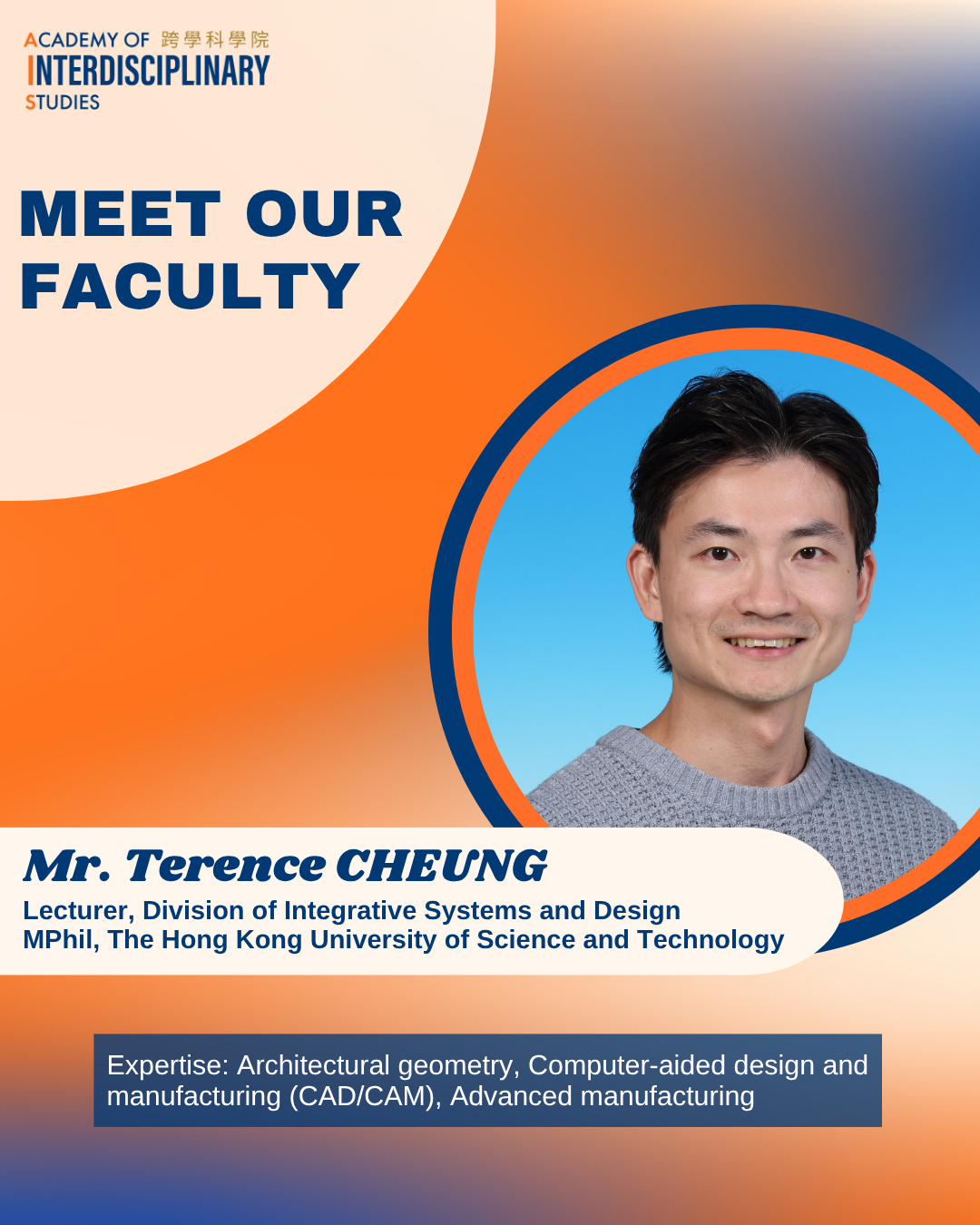
Join us in welcoming Mr. Terence CHEUNG, who has recently joined the Division of Integrative Systems and Design (ISD) as a Lecturer.
Since joining ISD as a Teaching Associate in 2020, Mr. Cheung has led the teaching support team and managed the lab “ISDworks!”, supported various courses and projects, and mentored student projects. With a strong background in engineering, Computer-Aided Design (CAD), and Computer-Aided Manufacturing (CAM), as well as extensive teaching and practical experience, he brings a wealth of expertise to his new role as Lecturer and is committed to inspiring the next generation of innovators.
Read on to learn more about his journey from HKUST alumnus to Lecturer, his passion for advanced manufacturing and material innovation, and the impact he hopes to make through teaching, research, and innovation.
-----
Could you tell us more about you?
I feel deeply honored to serve as a faculty member at HKUST, which is my alma mater. Beyond the guidance of the exceptional teachers who shaped my own academic journey, I have always been inspired by how energetic, creative, and well-rounded HKUST students are—not only pursuing academic excellence, but also actively driving meaningful contributions to society and local communities.
My primary focus is on advanced manufacturing and material innovation aimed at improving human health and quality of life. In this academic year, I look forward to teaching courses including ISDN 1001 “Introduction to Integrative Systems and Design”, ISDN 2300 “Introduction to 3D Design”, ISDN 3001 “Third Year Design Project I”, and ISDN 3002 “Third Year Design Project II”. My goal is to guide students to master the core concept of integrative systems and design, and to transform creative concepts into functional, real-world solutions.
What inspired you to specialize in this line of research?
My core motivation has always been a deep interest in understanding how things work and exploring new possibilities. I enjoy studying the foundational knowledge established by past researchers, but what truly excites me is testing novel ideas that have the potential to solve tangible everyday challenges. Research and engineering development are rarely straightforward; it is entirely natural to hit a dead end along the way. However, the sense of accomplishment from overcoming these setbacks and ultimately achieving a breakthrough is immense. Overcoming challenges and turning abstract design concepts into practical tools that help people is what drives my passion for this field every day.
What impact do you want your work to have on society?
I want my work to create practical, real-world value across both the built environment and the healthcare sector. By combining advanced manufacturing with smart material design, my goal is to drive innovation in architectural engineering, such as developing sustainable, high-performance facade systems while simultaneously advancing medical technology. Specifically, I am passionate about developing integrated sensing and material solutions for early-stage disease detection and personal health monitoring. Detecting health issues early can dramatically improve patient outcomes and reduce the pressure on public healthcare systems.
Do you have any advice for students interested in your research area?
My biggest piece of advice is to balance solid theoretical knowledge with active, hands-on experience. While textbook concepts and lectures provide essential foundations, true learning happens when you put those ideas into practice outside the classroom. Do not hesitate to build prototypes, test materials, and experiment with your own design concepts.
Could you share a fun fact about you?
When I am not in the lab or office, I spend much of my free time running and hiking around Hong Kong! Climbing steep mountain trails can be exhausting, but the view from the top is always worth the effort. Hong Kong has amazing natural scenery, where green hills meet the sea just minutes from the bustling city. Tackling tough trails and pacing long runs are a lot like solving complex engineering problems: both take endurance, planning, and resilience. Furthermore, reaching a scenic peak is the best way to clear my mind after a busy week of research.


