More about HKUST


Achievements
Community
Corporate Projects
Exchange
Field Trips & Visits
Internship & Career
Undergraduate
Office
Research
Seminars & forums
Student Activities
T&M-DDP
Postgraduate
EVMT
Innovation
Entrepreneurship
Sustainability
Engineering
Environment
Air Quality
GBA
PublicPolicy
ENVR
PPOL
Teaching&Learning
Technology
Research and Technology
Greater Bay Area
IIM
Fintech
Alumni
AMC
Art Management
Artificial Intelligence
Arts
ArtTech
Cultural Studies
DesignTech
Emerging Interdisciplinary Areas
EMIA
Extended Majors
Faculty
HealthTech
IDT
ISD
Machine Creativity
MarineTech
MPM
MPP
SustainableTech
TIE
TLE
Announcements & Office
Meet Our Faculty: Prof. WANG Haiping
08/09/2026
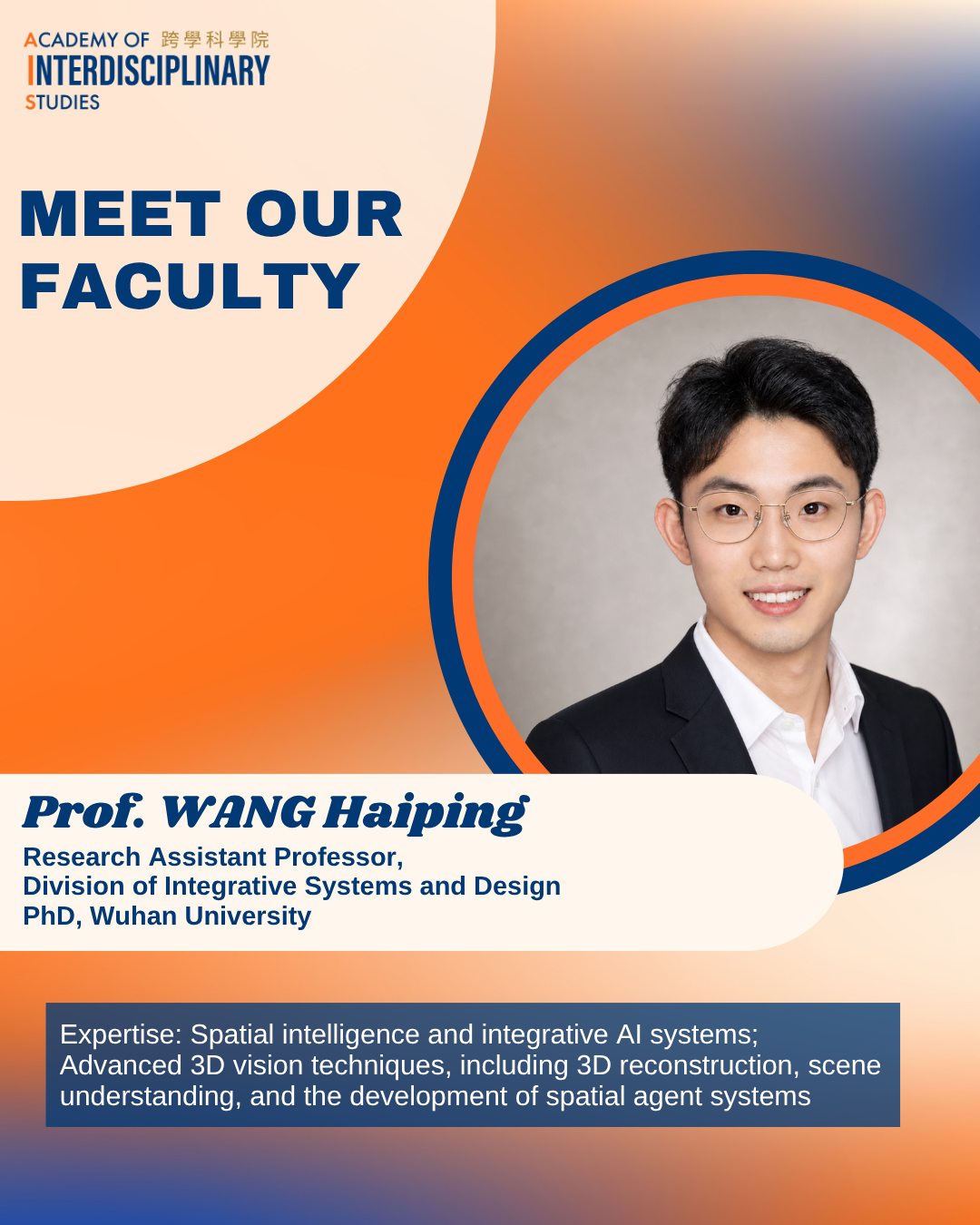
Welcome Prof. WANG Haiping, who has recently joined the Division of Integrative Systems and Design (ISD) as a Research Assistant Professor.
Driven by a passion for understanding cities, Prof. Wang develops AI-powered spatiotemporal intelligence systems that transform urban data into actionable insights. Inspired by the growing complexity of urban challenges, his research aims to support smarter city management, improve daily life for residents, and advance sustainable, people-centered urban development.
Read on to learn more about his passion for urban intelligence, his research at the intersection of AI and cities, and the impact he hopes to make through his work.
-----
Could you tell us more about you?
I grew up in Jinan, Shandong, a city known as the “City of Springs”. Before joining HKUST, I earned my PhD from Wuhan University. I first became familiar with HKUST through academic exchanges and collaborations with scholars here. Through these interactions, I came to appreciate HKUST as an open and energetic university that encourages collaboration across disciplines.
When I joined HKUST, I was excited by the research opportunities, and I was warmly welcomed by the community. My current research focuses on developing spatiotemporal intelligence systems that utilize AI to support urban management. I think HKUST is an ideal place for this work because interdisciplinary collaboration is deeply embedded in its culture.
What inspired you to specialize in this line of research?
My academic background is in surveying and remote sensing, a field focused on observing the world and understanding how it works. Cities are a core focus of our research because they are complex, dynamic systems where people, infrastructure, and the environment constantly interact.
As cities grow larger and urban challenges become increasingly complex, however, traditional approaches are often no longer efficient to provide a comprehensive understanding or timely support. At the same time, advances in AI have transformed many industries, greatly improving their efficiency and effectiveness. This has inspired me to explore how we can bring together vast amounts of urban data and AI to identify urban patterns, connect information, support complex reasoning, and ultimately enable more effective urban management decisions.
What impact do you want your work to have on society?
I hope our research can make a meaningful difference in people’s everyday lives while also supporting better urban management. For residents, it can make travel, service discovery, and activity planning more convenient. Instead of navigating multiple apps and websites, people will be able to simply describe their needs through a conversation. The system could then take into account factors such as transportation, facilities, environmental conditions, and accessibility to provide the best options.
For city managers, our work aims to provide a more integrated view of how different parts of a city interact with and influence one another. This will support decisions related to mobility, sustainability, infrastructure, economic development, and public services. In the long term, I hope this research can contribute to building cities that are not only more efficient and environmentally friendly, but also more pleasant places to live.
Do you have any advice for students interested in your research area?
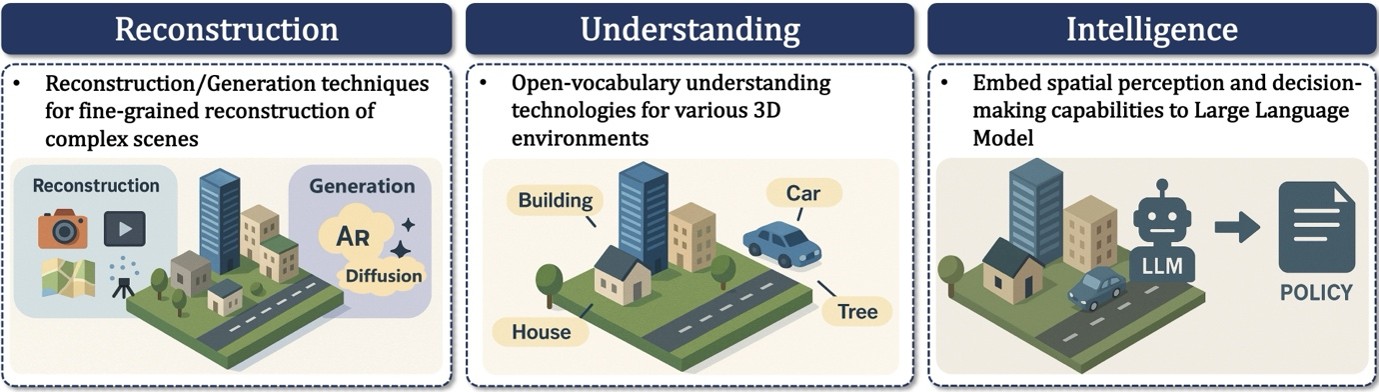
This is a broad and rapidly evolving field that spans areas such as urban sensing, 3D reconstruction, scene understanding, and human-machine interaction. My advice is to stay curious, but not to chase every new trend. Instead, focus on building a strong foundation in one area and then gradually explore how it connects with other fields. Begin with a specific and meaningful problem. Ask yourself what you are trying to solve, why it matters, and who might benefit from the solution. Once you have thought through these questions, consider which technical approaches could help address the problem.
Could you share a fun fact about you?
I once successfully lost 15 kilograms, which made me feel more energetic.