More about HKUST


Achievements
Community
Corporate Projects
Exchange
Field Trips & Visits
Internship & Career
Undergraduate
Office
Research
Seminars & forums
Student Activities
T&M-DDP
Postgraduate
EVMT
Innovation
Entrepreneurship
Sustainability
Engineering
Environment
Air Quality
GBA
PublicPolicy
ENVR
PPOL
Teaching&Learning
Technology
Research and Technology
Greater Bay Area
IIM
Fintech
Alumni
AMC
Art Management
Artificial Intelligence
Arts
ArtTech
Cultural Studies
DesignTech
Emerging Interdisciplinary Areas
EMIA
Extended Majors
Faculty
HealthTech
IDT
ISD
Machine Creativity
MarineTech
MPM
MPP
SustainableTech
TIE
TLE
Announcements & Office
Meet Our Faculty: Prof. Kathy LEUNG
27/05/2026
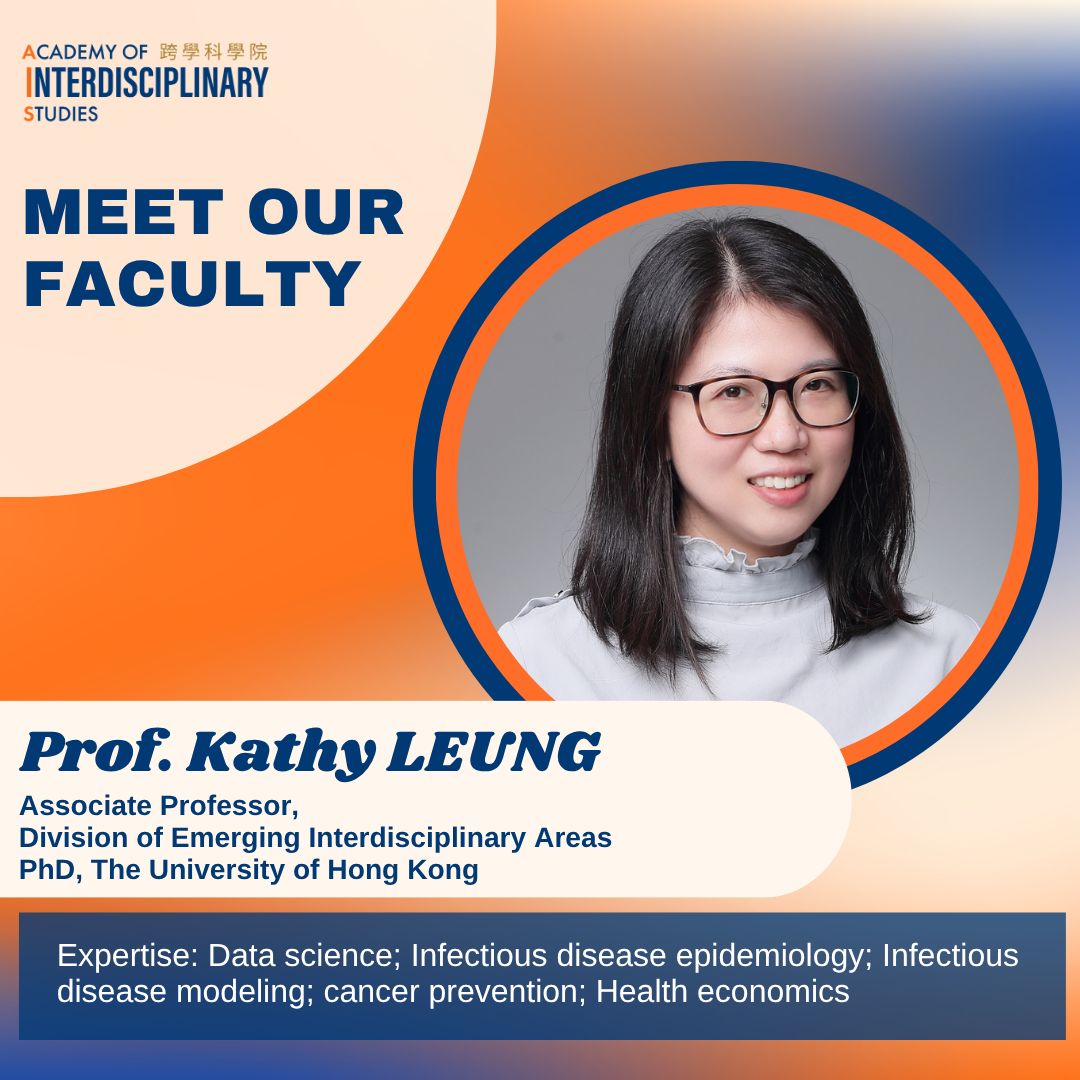
Get to know our new faculty – Prof. Kathy LEUNG, Associate Professor in the Division of Emerging Interdisciplinary Areas (EMIA)!
From modeling infectious diseases to diving deep into data science, cancer prevention, and health economics, Prof. Leung’s research is tackling some of today’s most critical health challenges.
Read on to discover her research journey, advice for students, and hobby outside of work.
-----
Could you tell us more about you?
I join HKUST after serving as an Assistant Professor at the LKS Faculty of Medicine, The University of Hong Kong. My academic background includes a B.S. in Biological Sciences and a B.A. in Economics from Peking University, followed by my MPhil and Ph.D. from The University of Hong Kong. I am excited to join the Division of Emerging Interdisciplinary Areas (EMIA) as it offers the unique opportunity to bridge mathematical modeling and data science with real-world health policy. This interdisciplinary environment is crucial for tackling critical challenges, like pandemic preparedness, and evaluating health interventions.
My research develops mathematical models and statistical inference techniques to provide timely, actionable public health insights. I model a wide range of communicable and non-communicable diseases, including influenza, RSV, COVID-19, and various cancers. I also conduct epidemiological and economic evaluations of intervention strategies, such as vaccination and risk-based cancer screening programs. Furthermore, I am exploring the use of data science and AI to enhance early disease detection and clinical decision support.
What inspired you to specialize in this line of research?
My specialization in infectious disease epidemiology and modeling is fundamentally driven by the critical need for evidence-based decision-making during public health emergencies. I was inspired by the unique intersection of my undergraduate background in both biological sciences and economics, which gave me a dual perspective: viewing disease not just as a biological event, but one with profound economic and social consequences. This focus allows me to ensure that rigorous quantitative analysis provides timely, actionable forecasts and cost-effectiveness evaluations that directly guide public health policy and save lives. The greatest inspiration is translating data into intelligence that policymakers can use to rapidly and effectively respond to evolving health threats.
What impact do you want your work to have on society?
I hope my work can enhance global public health preparedness and ensure that critical policy decisions are founded on robust and timely evidence. During the COVID-19 pandemic, this translated into direct, high-impact work, where I served as a lead data analyst providing real-time nowcasting and forecasts to the Hong Kong government between 2020 and 2023, and acted as an expert advisor to the Chinese Centre for Disease Control and Prevention between 2021 and 2024. This experience underscores my belief in rapidly translating complex mathematical models into actionable intelligence for crisis management.
Moving forward, I aim to extend this influence globally through high-level advisory roles. These include my membership on the World Health Organization’s Advisory Committee on Immunization and Vaccines-related Implementation Research (IVIR-AC) and my service as a consultant for their technical consultations on malaria multi-model comparison of prioritized interventions (M3CPI) and multi-model comparisons for typhoid conjugate vaccine adequate schedules (MMC-TAS). By engaging in these roles and serving on the editorial boards of key journals like Epidemics and Proceedings of the Royal Society B, I seek to set rigorous scientific standards that help build resilient and data-driven public health systems worldwide.
Do you have any advice for students interested in your research area?
I encourage students to focus on two core pillars: building strong quantitative skills and embracing an interdisciplinary mindset. While curiosity and experimentation are crucial—and many insights do emerge from testing hypotheses and learning from unexpected results—it’s important to first become proficient in handling and cleaning the often messy and complex real-world epidemiological datasets. This requires a strong foundation in mathematics and statistics.
Second, embrace interdisciplinary collaboration; this field inherently requires blending expertise in biology, mathematics, computer science, and public health policy. Finally, be inquisitive and persistent. Mathematical modeling involves a lot of trial and error, and the ability to learn from unexpected results and constantly refine your approach is essential for driving meaningful advancements.
Could you share a fun fact about you?
Beyond my academic life in infectious disease epidemiology, I maintain a part-time role as a scientific advisor for several WeChat public accounts, where I translate complex public health and epidemiological findings into accessible information for the public. Outside of work, I like hiking as it helps me recharge and meditate.


