More about HKUST


Achievements
Community
Corporate Projects
Exchange
Field Trips & Visits
Internship & Career
Undergraduate
Office
Research
Seminars & forums
Student Activities
T&M-DDP
Postgraduate
EVMT
Innovation
Entrepreneurship
Sustainability
Engineering
Environment
Air Quality
GBA
PublicPolicy
ENVR
PPOL
Teaching&Learning
Technology
Research and Technology
Greater Bay Area
IIM
Fintech
Alumni
AMC
Art Management
Artificial Intelligence
Arts
ArtTech
Cultural Studies
DesignTech
Emerging Interdisciplinary Areas
EMIA
Extended Majors
Faculty
HealthTech
IDT
ISD
Machine Creativity
MarineTech
MPM
MPP
SustainableTech
TIE
TLE
Announcements & Office
HKUST Co-Establishes Beijing Key Laboratory for Meteorological Artificial Intelligence
05/05/2026
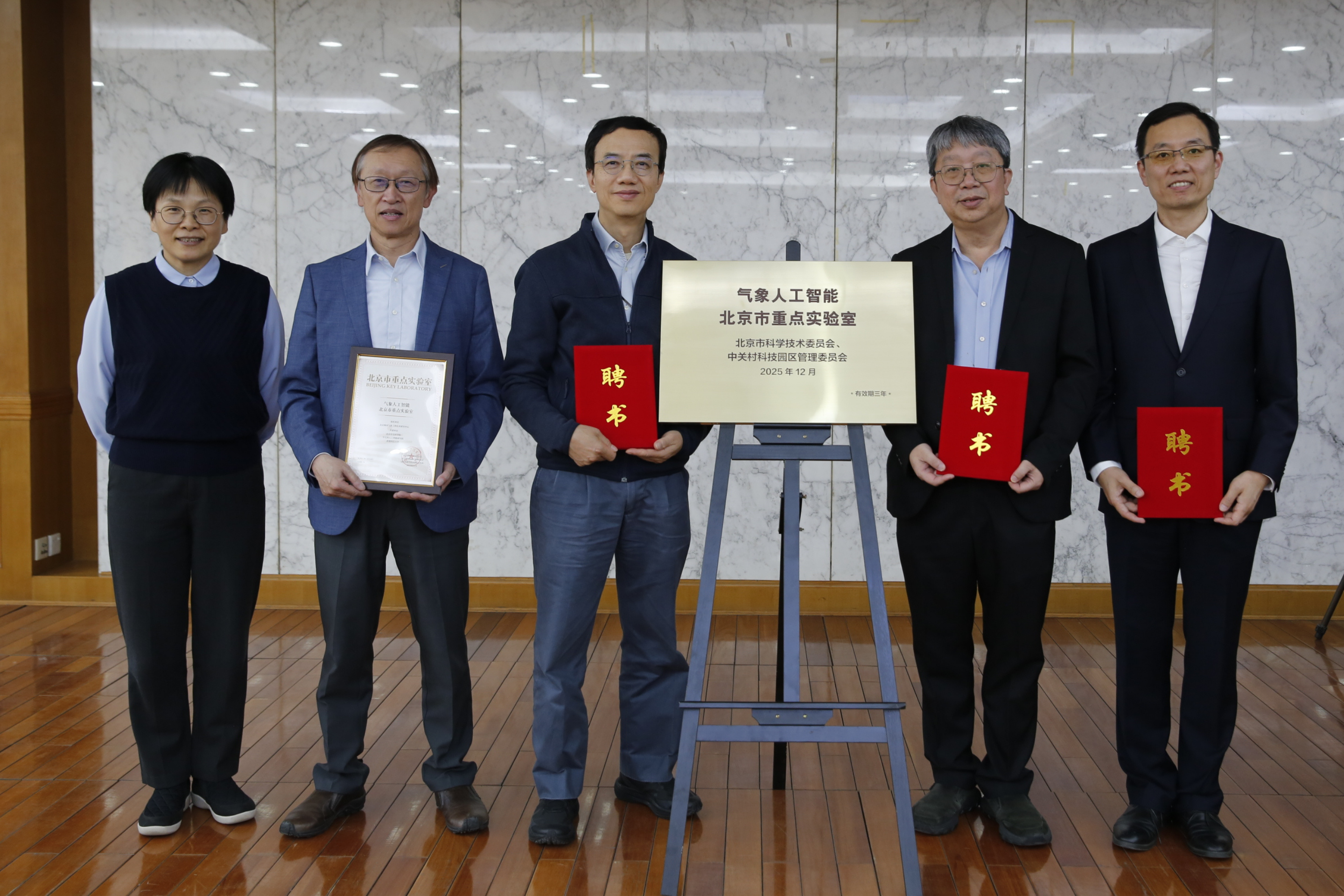
HKUST has officially become one of the co-establishing partners of the Beijing Key Laboratory for Meteorological Artificial Intelligence. Prof. Alexis LAU, Head of the ENVR at HKUST (second right), has been appointed Deputy Director of the laboratory; Prof Jimmy FUNG (third left), HKUST Associate Provost (Teaching and Learning), has been appointed as Scientific Advisory Committee; and Prof. CHEN Fei (second left), Associate Head of ENVR at HKUST shared insights on urban weather forecasting at the seminar.
The Hong Kong University of Science and Technology (HKUST) has co-established the “Beijing Key Laboratory for Meteorological Artificial Intelligence”, which officially launched on April 17, 2026. The laboratory is led by the Beijing Urban Meteorological Engineering Technology Research Center (Institute of Urban Meteorology, CMA, Beijing), with co-founding partners including HKUST, Zhongguancun Academy, and Zhongguancun Institute of Artificial Intelligence.
Prof. Alexis LAU, Head of the Division of Environment and Sustainability (ENVR) at HKUST, has been appointed as Deputy Director of the laboratory, while Prof. Jimmy FUNG, Associate Provost (Teaching & Learning) at HKUST, has been appointed to the Scientific Advisory Committee.
Advancing AI Innovation for Meteorological Science and Climate Applications
The laboratory aims to serve as a key platform for promoting independent innovation in core meteorological artificial intelligence technologies. Its research will focus on key areas including artificial intelligence in meteorological observation, forecasting and early warning of extreme weather events, climate change adaptation, and urban intelligent meteorological services. By integrating scientific research resources, the laboratory will establish a full-chain innovation system spanning “monitoring – forecasting – services – industry” to develop demonstration projects and benchmark application scenarios, and support the large-scale implementation of related technologies in Beijing.
Prof. Alexis LAU, Head of ENVR at HKUST, emphasized that the establishment of the Beijing Key Laboratory for Meteorological Artificial Intelligence represents an important step toward integrating advanced artificial intelligence technologies with next-generation weather and climate science. “The Laboratory’s focus on urban prediction aligns closely with our Division’s efforts to improve forecasting in complex coastal urban environments. By combining strengths in atmospheric science, data science, and urban applications, the laboratory will advance early warning capabilities for extreme weather and climate risks.”
Driving Strategic Research Excellence Through High-Level Academic Engagement
Approved for establishment in December 2025, the inauguration ceremony and a regional meteorological artificial intelligence forecasting seminar were held at the Beijing Meteorological Service on April 17, 2026. Distinguished guests from the scientific and policy communities attended the event, including SHI Xuefeng, Deputy Director General of Department of Science, Technology and Climate Change, China Meteorological Administration(CMA); Dr. XUE Hongxi, Deputy Director-General of Department of Forecasting and Networking, CMA; SHEN Xueshun, Academician, Chinese Academy of Engineering; DU Shengli, Deputy Director of Information Technology Development Center, Beijing Municipal Science & Technology Commission, Administrative Committee of Zhongguancun Science Park, alongside HKUST delegates. The event was chaired by ZONG Zhiping, Member of the Party Leadership Group and Deputy Director of the National Meteorological Center of CMA.
Following the inauguration, the laboratory convened its first Academic Committee meeting to further define the laboratory’s research priorities and operational framework, laying a strong foundation for high-impact research, effective resource integration, and contributions to regional meteorological advancement.
Prof. Jimmy FUNG, Associate Provost (Teaching & Learning) at HKUST stated: “This collaboration reflects HKUST’s proactive efforts in advancing the development of artificial intelligence in meteorological science and regional urban innovation. It further strengthens regional cooperation and supports the development of scalable AI-driven technologies to enhance climate resilience and provide decision-making support for rapidly evolving urban systems. With extreme weather events becoming increasingly frequent, forecasting and early warning systems are under growing pressure to improve lead time, accuracy and coverage. The application of artificial intelligence is offering innovative and practical pathways to overcome these critical challenges.”
Prof. Fei Chen, Associate Head and Professor of ENVR at HKUST said, “Hong Kong has been selected as a demonstration city under the WWRP Urban-PREDICT initiative, providing a unique real-world environment for advancing next-generation urban weather forecasting. The establishment of this laboratory creates strong synergies between ongoing international efforts and regional innovation in meteorological artificial intelligence. By integrating insights from diverse urban test-beds such as Hong Kong and Beijing, we can accelerate the development of scalable, AI-enabled forecasting systems. These advances will not only enhance resilience in major cities, but also contribute to the global scientific community through the World Meteorological Organization framework.”
HKUST Pioneers AI-Driven Solutions for Smart Cities, Climate Resilience, and Public Safety
ENVR will continue to leverage its interdisciplinary strengths in environmental science and artificial intelligence to advance talent development and strengthen research collaboration, while playing a pioneering role in translating research into impact. Through the development and application of pioneering AI-enabled meteorological innovations, the Division aims to contribute to smart city development, strengthen climate resilience and enhance public safety.
HKUST has officially become one of the co-establishing partners of the Beijing Key Laboratory for Meteorological Artificial Intelligence. Prof. Alexis LAU, Head of the ENVR at HKUST (second right), has been appointed Deputy Director of the laboratory; Prof Jimmy FUNG (third left), HKUST Associate Provost (Teaching and Learning), has been appointed as Scientific Advisory Committee; and Prof. CHEN Fei (second left), Associate Head of ENVR at HKUST shared insights on urban weather forecasting at the seminar.


