More about HKUST


Achievements
Community
Corporate Projects
Exchange
Field Trips & Visits
Internship & Career
Undergraduate
Office
Research
Seminars & forums
Student Activities
T&M-DDP
Postgraduate
EVMT
Innovation
Entrepreneurship
Sustainability
Engineering
Environment
Air Quality
GBA
PublicPolicy
ENVR
PPOL
Teaching&Learning
Technology
Research and Technology
Greater Bay Area
IIM
Fintech
Alumni
AMC
Art Management
Artificial Intelligence
Arts
ArtTech
Cultural Studies
DesignTech
Emerging Interdisciplinary Areas
EMIA
Extended Majors
Faculty
HealthTech
IDT
ISD
Machine Creativity
MarineTech
MPM
MPP
SustainableTech
TIE
TLE
Announcements & Office
Meet Our Faculty: Prof. ZHAN Fangneng
25/03/2026
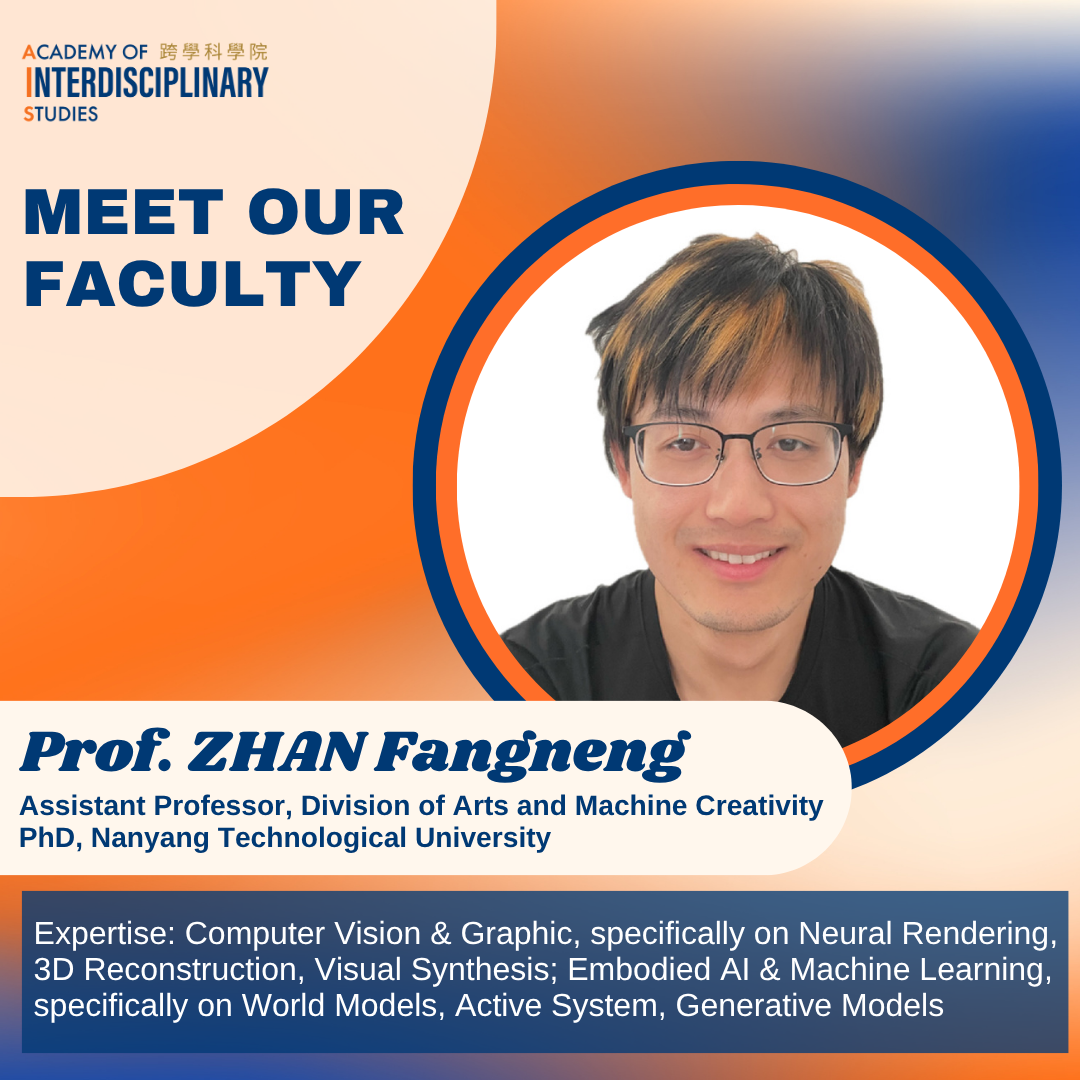
Let’s welcome our new faculty Prof. ZHAN Fangneng, Assistant Professor in the Division of Arts and Machine Creativity!
Specializing in computer vision and graphics, as well as embodied AI and machine learning, and with research experience at prestigious international institutions including the Max Planck Institute for Informatics, Harvard, and MIT, Prof. Zhan is currently developing autonomous rendering systems that self-optimize to independently create 3D representations and rendering processes.
Discover how his work could reshape the way intelligent systems support people in complex, real-world tasks — read on to learn more about his research, inspirations, and what’s next.
-----
Could you tell us more about you?
I am originally from Hubei, a province in central China, and received my PhD from Nanyang Technological University in Singapore. Before joining HKUST, I worked as a postdoctoral researcher at the Max Planck Institute for Informatics in Germany and later as a research fellow collaborating with researchers at Harvard University and MIT.
I joined HKUST because it offers a highly international and competitive research environment with strong strengths in artificial intelligence, robotics, and data science. I believe HKUST provides an ideal platform for developing interdisciplinary research and collaborating with outstanding students and colleagues.
Currently, my research centers on video generation models and 3D world models, exploring how AI systems can learn predictive representations of dynamic environments. In the coming Spring term, I will also be teaching courses related to computer vision and AI, where I hope to introduce students to both the fundamental principles and the latest advances in visual intelligence.
What inspired you to specialize in this line of research?
My interest in this field began during my undergraduate years, when I became fascinated by virtual reality and artificial intelligence. I realized that computer vision and 3D visual computing could serve as a bridge between the physical and digital worlds, enabling machines to perceive and interact with their environments in meaningful ways. This realization sparked my long-term interest in visual intelligence.
During my PhD, I worked extensively on image synthesis and neural rendering, exploring how machines can generate and manipulate visual content. This experience gradually led me to broader questions about how AI systems can understand and model the visual world itself. Influential ideas, such as GAN-based generative learning, and later neural scene representations, like NeRF, helped shape my research perspective.
What impact do you want your work to have on society?
I hope my research can contribute to building AI systems that better understand and interact with the physical world. By developing models that can learn and simulate 3D environments from visual data, we move closer to creating intelligent systems that can support humans in complex real-world tasks.
These technologies could benefit a wide range of applications. For example, in robotics and autonomous systems, better visual world models could enable machines to navigate and interact with environments more safely and efficiently. In areas such as augmented reality, digital content creation, and immersive media, generative visual models can significantly enhance how we experience and interact with digital environments.
Do you have any advice for students interested in your research area?
I encourage students to develop curiosity and explore ideas through experimentation. Many important research insights emerge from implementing systems, testing hypotheses, and learning from unexpected results. Practical experience with coding and building models is extremely valuable.
Besides, research is often a long and iterative process. It is important to stay patient and resilient, and to accept that trial and error are natural parts of scientific discovery. Over time, by continuously exploring problems and refining ideas, students will gradually develop their own research perspectives and creative approaches.
Could you share a fun fact about you?
Outside research, I enjoy exploring new places and learning about different cultures. Having lived and worked in several countries, including Singapore, Germany, and the United States, I have had the opportunity to experience a wide range of academic environments and cultural perspectives. These experiences have broadened my outlook and often inspire new ways of thinking about research problems.